When Should Businesses Hire DevOps Engineers for Cloud-Scale Delivery?

It might be helpful to hire DevOps engineers mainly for cloud-based deliveries in some cases when development teams get huge (generally 5-10 developers), infrastructures grow complex, complex deployment processes take over manual functions, and stability and uptime are vital after having reached the critical growth stage. The other situation where implementing DevOps becomes necessary occurs in a more mature organization if the edge is gained over manual methods in terms of cost efficiency, quicker releases, and enhanced security. Bringing in DevOps at this stage is more of a strategic decision to support sustainable growth and avoid the lengthy hiring cycles that can slow progress.
This blog aims to discuss the most important reasons to consider hiring a DevOps engineer for your business, while considering why the integration of DevOps in 2026 significantly boosts development efficiency and productivity.
Table of Contents
What is DevOps?
DevOps is a practice that combines the development and operations teams by causing less delay in the execution and operation of application development. Hire DevOps engineers to ensure that these DevOps methods, including the culture of isolating multiple areas by designing them, the operations teams, and even the businesses, using automation, CI/CD, and feedback mechanisms, are implemented effectively. It seeks to accelerate development, improve efficiencies, and ensure that applications remain fully operational from planning through deployment and monitoring, as required by the business.
Read More : How to Choose the Right DevOps Consulting Companies?
Signs Your Business Needs to Hire DevOps Engineers
As a business grows and technology becomes more complex, the need for efficient systems becomes paramount. Increasingly essential, when you decide to hire DevOps engineers, it is no longer a luxury; it’s a strategic decision that can transform how an organization builds, deploys, and manages applications for faster delivery, better reliability, and cost-effective operations.
DevOps relates to IT operations (Ops) and software development (Dev) to streamline the complete software development life cycle. Leadership and collaboration between teams, automation implemented, and collaboration established are key components of DevOps, which help drive continued and highly consistent delivery of quality applications. It is important to engage DevOps expertise in a business that is moving up in complexity, where infrastructure has become complex, and manual processes have begun to inhibit deployment pipelines. Implementing DevOps automation can further enhance efficiency, reduce errors, and accelerate release cycles.
Consider the following indicators as the right time to seek out DevOps consulting services:
Team size and bottlenecks
When your development team becomes larger, let’s say around 5–10 members, and most of their time is consumed in managing deployments and infrastructure rather than writing code, it becomes quite an indicator that you need to hire DevOps engineers to take away a good part of the operational duty while working on keeping processes running smoothly.
Scalability Challenges
As you move from an MVP to frequent feature releases, creating a stable and scalable infrastructure becomes crucial. A DevOps engineer makes systems scalable for your growth. This entails containerization, cloud solutions, and automated scaling. The holistic approach ensures application performance in a stable state as workloads increase.
Deployment Blocks
Frequent failures in deployment, slow-release cycles, and server-management issues are signals of a suboptimal pipeline. Hire DevOps engineers as they can help build advanced CI/CD pipelines to automate testing and deployment functions and thereby reduce human errors, hasten time-to-market, and ensure more reliable and predictable deliveries.
Manual and Repetitive Processes
Organizations relying heavily on manual provisioning of servers, environment configuration, or resource scaling will induce errors, delays, and an increase in wasted time. DevOps engineers help by streamlining these operations, creating standardized workflows that increase speed, consistency, and accuracy while reducing operational overhead.
Infrastructure Complexity and Rising Costs
Managing complex cloud services, infrastructure, and codebases requires specialized skills for proper oversight. Unsurprisingly, these costs soon spiral without close monitoring. DevOps professionals come to the fore on beneficial resource utilization, new and cost-effective cloud solutions, and ensuring scalable and resilient systems with less maintenance at less expense.
Weak Collaboration Poor Productivity
When development and operations work in isolation, there is potential for miscommunication and redundant work that can harm overall productivity. Hire DevOps engineers to foster a culture of collaboration while easing workflows and implementing some automated tools that they might accomplish as a highly integrated team in the delivery of software.
Weak Monitoring, Logging, and Security
Inadequate monitoring and logging could lead to a delay in resolving problems, which can impact uptime and system reliability. DevOps teams move on to building and driving comprehensive monitoring solutions for proactive troubleshooting. Security practices are integrated into the development life cycle by practicing DevSecOps and driving the process of fixing any vulnerabilities and ensuring that the reliability and availability of critical services are rarely compromised, establishing an ongoing, compliant, secure, and resilient system.
Business-Critical Operations
When companies face no alternatives outside of high availability, high quality, and rapid release into production, DevOps is not so much an option anymore; it becomes mandatory. Hire DevOps engineers to ensure operational stability, and the reliability and availability of critical services are rarely compromised, even during peak processing capacity or unexpected challenges.
Issues of Scalability
Increased user demand or workload can cause system bottlenecks without planned scalability. The architectures put in place by DevOps professionals will keep a system growing smoothly with adequate control of performance and reliability.
Key Considerations Before You Hire DevOps Engineers
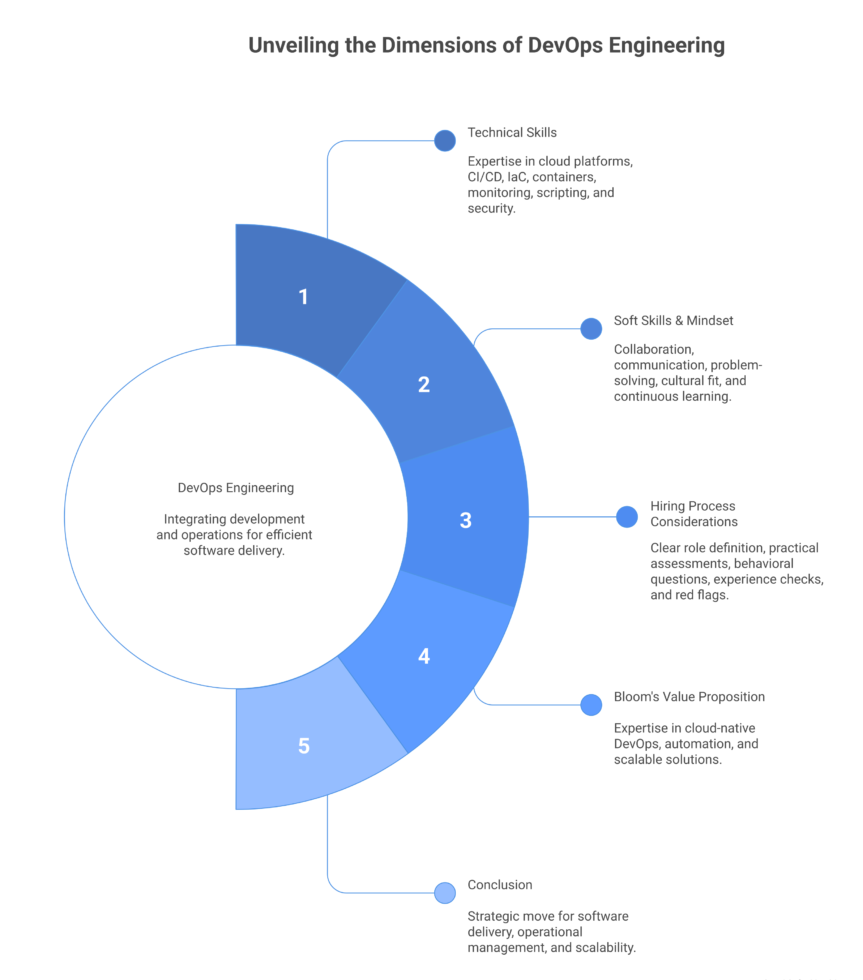
Technical expertise and collaboration abilities, experience in that field and hands-on experience are fundamental for DevOps engineers in order to develop an automated, accurate, scalable, and secure foundation for software development.
| Category | Key Points | Details / Examples |
| Technical Skills | Cloud Platforms | Experience with networking, administration, and security in Azure, Google Cloud, or AWS cloud environments. |
| CI/CD | Hands-on experience with Jenkins, CircleCI, GitLab, or similar tools to automate pipelines. | |
| Infrastructure as Code (IaC) | Hands-on experience with CloudFormation, Terraform, or other IaC toolsets. | |
| Containers & Orchestration | Hands-on experience with containers using Kubernetes and Docker for management and orchestration. | |
| Monitoring & Logging | Hire DevOps developer with practical experience in setting up and managing monitoring tools such as Prometheus, Grafana, or the ELK stack. | |
| Scripting & Automation | Expertise in Bash, Python, or other scripting languages is required for automation tasks. | |
| Security (DevSecOps) | Focus on automating processes to ensure the security of CI/CD pipelines. | |
| Soft Skills & Mindset | Collaboration | Ability to identify issues and provide solutions across teams, improving collaboration between Dev, QA, Operations, and Security. |
| Communication | Hire DevOps engineers to effectively share knowledge across teams, clearly communicating experiences and insights. | |
| Problem-Solving | Remains calm under pressure and has practical experience in troubleshooting issues. | |
| Cultural Fit | Easily adapts to the company’s culture of collaboration and innovation. | |
| Continuous Learning | Eager to learn and adapt to new tools and technologies, and continuously improve skills. | |
| Hiring Process Considerations | Clear Role Definition | Identify gaps and areas where the business requires assistance. |
| Practical Assessments | Hire DevOps engineers as they create exercises and scenario tests to evaluate real-world skills. | |
| Behavioral Questions | Encourage candidates to share past experiences in teamwork, problem-solving, and collaboration. | |
| Check Experience | Ensure skills are demonstrated practically, not only listed as certifications. | |
| Red Flags | Short-term jobs or employment gaps may indicate potential future issues. |
Why Hire DevOps Engineers from Bloom?
Bloom draws upon its vast experience with DevOps engineering in cloud-native DevOps, automation, and scalable infrastructure solutions. Our professionals achieve a smooth integration of development and operations by building reliable CI/CD pipelines, Infrastructure as Code (IaC), containerization, and proactive monitoring for faster, robust, and secure software delivery. Besides being technically reliable, Bloom engineers come with strong collaborative skills and an ability to solve problems. We demonstrate a continuous eagerness to learn and work seamlessly with your team and culture. For businesses that choose Bloom, they hire DevOps engineers to optimize cloud costs, and productivity is surely propelled toward software-system maturity, whether scaling or not. Once with Bloom, your trusted partner, the business is enabled to expand while preserving the quality, security, and productivity of operations.
DevOps: The Key to Cloud-Scale Success

Conclusion
When you decide to hire DevOps engineers, it is a strategic move that can greatly motivate the introduction of such technologies in the delivery of software, management of operational duties, and scalability. If focused growth, complex infrastructure, slower deployments, uptime struggles, or inefficient capacity act as triggers for the right time to bring in DevOps practices, then businesses can expect more effective, highly stable deployments with reduced production risks and cost efficiencies.
Evaluating technical skills along with soft skills, as well as culture fit and hands-on experience, becomes imperative in the actual selection of professionals or teams. When hiring is approached thoughtfully, DevOps practices deliver significant value by increasing security, enabling collaboration, and supporting a thriving, scalable infrastructure for growing businesses, while fostering innovation with long-term operational support.
If you want to hire DevOps engineers, contact us today!
Frequently Asked Questions
Q1. What does a DevOps engineer do?
A DevOps engineer serves as an efficient link between IT operations and software development. They automate processes while managing infrastructure that runs on the cloud and ensure reliable delivery through scalable and secure applications.
Q2. When do you need a dedicated DevOps Engineer?
If your development team grows to around 5–10 members, deployment cycles slow down, infrastructure becomes complex, uptime becomes critical, or automation and cost optimization become a focus, you need to hire DevOps engineers.
Q3. What skills should a DevOps engineer have?
The particular set of competencies includes CI/CD, cloud platforms (AWS, Azure, GCP), IaC (Terraform, CloudFormation), containerization (Docker, Kubernetes), monitoring (Prometheus, Grafana), scripting (Python/Bash), and DevSecOps. Soft skills include collaboration, communication, problem-solving, cultural fit, and continuous learning.
Q4. What are the benefits of hiring DevOps engineers?
When developers demonstrate strong creativity, leadership, technical skills, collaborative behavior, advanced technology skills, and support mutual growth.
Q5. Can DevOps engineers work remotely?
Yes, DevOps engineers can manage cloud infrastructure automation, pipelines, and monitoring tools remotely, thereby making distributed teams more effective.
Q6. Can a DevOps engineer work as a cloud engineer?
A DevOps engineer can definitely work as a cloud engineer and, in most cases, does so, as the roles tend to greatly overlap, blurring the boundary between the two in many modern job titles. Hire DevOps engineers for these roles, which often focus on automating and managing cloud infrastructure (AWS, Azure, GCP) and are frequently referred to as Cloud DevOps engineers. Automation, CI/CD, and scripting skills form a solid foundation for cloud roles focused on managing scalable and resilient cloud environments.
Q7. What are the 7 C’s of DevOps?
The principles of continuous development, integration, testing, deployment or delivery, monitoring, feedback, and operations ensure a rapid, repeatable, and reliable software delivery model. These principles emphasize automation, collaboration, and quality across recurring processes for building, deploying, and maintaining systems.
Q8. What You Need to Know When Hiring DevOps Engineers?
It is important that you hire DevOps engineers who have key technical skills, including cloud platforms, CI/CD, infrastructure as code, containers, monitoring, and security, along with soft skills such as collaboration, an automation mindset, problem-solving, and continuous learning. Look for individuals who can act as a bridge between Dev and Ops, enable automation, and drive efficiency, while fitting the cultural and tooling ethos of your organization. Real-world assignments should be used to test practical skills.
Q9. What are the 5 W’s of DevOps?
The 5 W’s of DevOps provide a structured way to understand it: What (the practice of bridging Dev and Ops), Why (faster delivery and better quality), Who (Dev, Ops, QA, Business), When (continuously throughout the lifecycle), and Where (across the entire SDLC and toolchain), along with the how (automation and CI/CD) to support cultural alignment and continuous improvement in software delivery.
Q10. Why adopting a DevOps Approach is Crucial for your business?
Businesses must adopt DevOps to achieve agility, speed, and reliability in software delivery, enabling faster innovation. Hire DevOps engineers to improve collaboration between Dev and Ops teams, enhance operational security, and achieve significant cost savings through automation, leading to improved customer satisfaction and stronger market competitiveness in fast-moving markets. DevOps encourages breaking down silos, fostering continuous improvement, and enforcing automated workflows to respond to market trends.


Recent Posts
- Azure Cloud Architecture Explained: A Simple Guide for Enterprises
- CI/CD Pipeline Setup in Azure: Best Practices for 2026
- DevOps vs DevSecOps: What’s the Difference?
- Hire Azure DevOps Developers Who Deliver Faster, Secure CI/CD Pipelines
- Azure Virtual Machines vs Containers: What’s Right for Your Infrastructure?