Azure AI Studio vs Azure AI Foundry: Which one is better?

In a world driven by continuous experimentation and results, organizations are looking for market-oriented AI solutions that can be implemented without disruptions. This is where the Microsoft platform stands out by providing an AI ecosystem where businesses can produce comprehensive AI functionalities. In this regard, the debate between Azure AI Studio vs Azure AI Foundry becomes more evident. This indicates that Microsoft is dedicated to empowering businesses by providing an end-to-end platform for building AI apps for real-world uses.
Table of Contents
Azure AI Studio Vs Azure AI Foundry: Getting to know the Concepts
Microsoft Azure AI services include Azure AI Studio, which is a single platform that lets teams work on and build AI applications. It makes it easy for enterprises to design, test, evaluate, and deploy AI apps. By bringing together Azure machine learning tools, Azure OpenAI Service, and other Azure AI technologies into one place, it makes AI initiatives easier. When it comes to Azure AI Studio vs Azure AI Foundry, the first one is mostly utilized for building, testing, and evaluating AI applications.
Azure AI Foundry is a full-fledged platform for developing and running AI capabilities on a large scale. It is a core part of the Azure AI platform, given that it supports the entire AI lifecycle, right from coming up with ideas, making prototypes, deploying, monitoring, to optimizing them. In the discussion of Azure AI Studio vs Azure AI Foundry, the latter is more focused on putting AI to use on a large-scale source rather than focusing on individual experiments.
Azure AI Studio vs Azure AI Foundry: Key Differences
Both are Microsoft products operating on the same platform. The main difference between Azure AI Studio and Azure AI Foundry lies in their scope, usage, customer experience, and degree of control.
| Differences | Azure AI Studio | Azure AI Foundry |
| 1. Purpose & Function | With Azure AI Studio, teams can develop generative AI apps and try out alternative models, prompts, and retrieval-augmented generation (RAG) workflows. | It is an AI framework and platform that supports every step of the AI process, from developing ideas and prototypes to deploying and improving solutions across an organization. |
| 2. Audience & Usage | In the evaluation of Azure AI Studio vs Azure AI Foundry, the former is for Engineers, data scientists, and AI experts who want to develop and test AI solutions. | IT managers, developers, and other business experts find this more suitable because they can manage, operate, and expand their systems from one place. |
| 3. Tools & Functions | It lets you do prompt engineering, performance checking, RAG agent building, draw AI safety guardrails, and low-code development to speed up testing. | It provides agent service for businesses, pre-made templates, robust SDK, and access to a big catalogue of models. |
| 4. Development environment and Framework | In the Azure AI Studio vs Azure AI Foundry debate, the former is mainly preferred for evolving and testing new ideas. | It lays out the framework for managing agents, models, APIs, and security from a single platform. |
| 5. Exploring and Testing New ideas | It shows results quickly, and these results can be easily tweaked. It is prompt in making and testing AI-based apps. | It focuses on operational control and provides users with the tools they need for governance, monitoring, and tracing. It also ensures AI safety operations like red teaming and enterprise configuration management. |
| 6. Business-ready solutions and scalability | Teams can use this to move their proof of concept from the testing stage to the deployment stage. | It is more suitable for enterprise-level AI systems. This is because regulated industries and large-sized businesses can use AI safely, abide by the rules, and monitor them all the time. |
Also Read: Top 7 Azure AI Foundry Features Every Enterprise Should Know
Azure AI Studio vs Azure AI Foundry: Which one is better?
It is not possible to pick one winner in the Azure AI Studio vs Azure AI Foundry comparison. Your business goals, specific use cases, scalability issues, and the level of AI adoption required will determine which one is suitable for you.
We have categorized a few conditions under which you can use Azure AI solutions.
You should go for Azure AI Studio when you want to-
- Make quick prototypes and test AI apps,
- Make generative AI-based tools like chatbots, copilots, and virtual assistants,
- Conduct quick iterations and prompt engineering,
- Try out and evaluate large language models (LLMs),
- Make retrieval-augmented generation (RAG) solutions,
- Make proof-of-concept versions before releasing full-fledged AI solutions to the entire organization,
You should go for Azure AI Foundry when you want to-
- Deploy and manage AI solutions across teams or departments at an enterprise level,
- Create and control AI agents that can function on their own for complex business needs,
- Abide by stringent rules for governance, security, and compliance.
- Use domain-specific or confidential business data to make models of your own.
- Centralize the management, monitoring, and optimization of the entire AI lifecycle,
- Turn AI pilots into full-fledged AI functionalities and run throughout the organization.
If your goal is to move from AI experimentation to enterprise-wide deployment, Azure AI Foundry offers the control, scalability, and compliance needed for long-term success.
Move From AI Pilot to Production

How can Bloom Consulting Services help you choose the right solution?
Bloom is a renowned IT consulting firm with more than ten years of experience helping businesses create, deploy, and scale cloud and AI solutions.
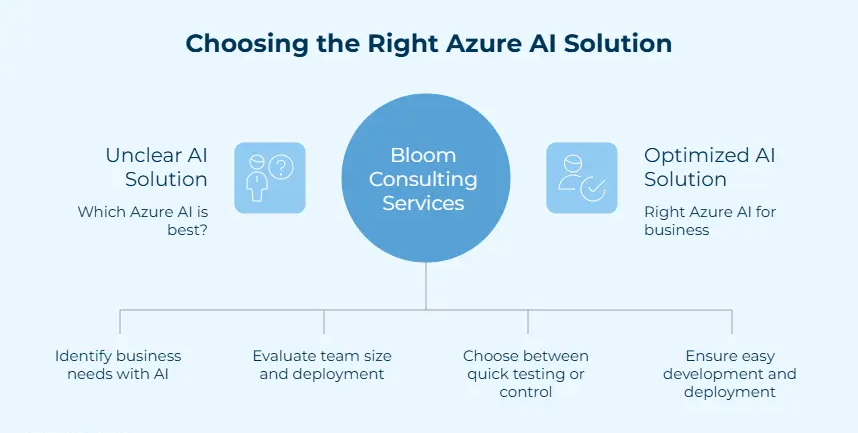
In the Azure AI Studio vs Azure AI Foundry debate, Bloom helps you choose the right one based on the following:
- Assessing Use Cases: We at Bloom assess Azure Machine Learning, Azure Cognitive Services, and Azure Bot Services to identify your business needs. This lets us decide if you need AI Studio for rapid prototyping or AI Foundry for enterprise-grade AI deployment.
- Analyzing Scale and maturity: We analyze the size of the team, experience in using AI, and how big the deployment will be. This helps you decide between fast experimentation and large-scale business operations.
- Deciding between Speed and Control: If you have to choose between speed and control, we recommend Studio for quick testing and iteration. On the other hand, Foundry for structured, controlled, and fully operational AI.
- Serving Future Needs: We make sure that the Azure AI services you choose can easily develop from a proof-of-concept to a full-scale deployment. We ensure this by using AI Foundry, Azure Machine Learning, and Azure Cognitive Services.
Conclusion
In the Azure AI Studio vs Azure AI Foundry discussion, businesses often feel overwhelmed. The former supplies tools to the teams that are needed to try out new ideas in no time, test models, analyze performance, and build AI apps quickly. This encourages new ideas and makes the process go faster during the idea stage. Azure AI Foundry, on the other hand, combines Azure AI Studio, SDKs, AI agents, and prebuilt templates into one platform. It helps companies develop AI solutions that can grow, are easy to administer, and are easy to work with.
This is why Microsoft Azure is considered the best Azure AI platform for enterprises. This allows you to come up with new ideas, test them faster, while still maintaining control and abiding by rules. Accordingly, you can choose the right platform for your business.
Do you want to begin your journey with Azure AI? Book a demo with us today!
Frequently Asked Questions
Q1. Does Azure AI Studio integrate with Azure AI Foundry?
AI Studio doesn’t connect directly to AI Foundry, but it does work with it. AI Foundry adds to the functionality of Studio, which was the core workspace before. It offers capabilities for businesses, such as governance, lifecycle management, agent services, SDKs, and deployment that may grow. To put it simply, Studio is the place where you can build and test things, and Foundry is the place where you can build a bigger AI platform.
Q2. What is the difference between Foundry and AI Studio?
AI Studio helps you construct AI apps in no time. This process involves prompt engineering, model testing, evaluation, and prototyping of generative AI and LLM-based apps. AI Foundry, on the other hand, is made to run AI at the business level. It adds management of the entire lifecycle, as well as governance, security, compliance, monitoring, and workflow coordination.
Q3. What is Azure AI Studio and Machine Learning?
AI Studio is a single place where teams can build generative AI apps. They can try out different models, design prompts, test agents, and quickly deploy AI-powered apps. On the contrary, Azure Machine Learning (Azure ML) is a complete ML platform that lets you train, refine, deploy, and manage machine learning models. It supports MLOps, pipelines, automated ML, and training models on a large scale. Both of them are parts of the larger Microsoft Azure AI ecosystem.
Q4. How does Azure AI Foundry work?
AI Foundry is an end-to-end AI platform that uses a unified hub-and-project architecture to handle the entire AI lifecycle. It helps businesses seamlessly move from Azure AI Studio use cases like prototyping, prompt engineering, etc., to Azure AI Foundry use cases like enterprise-grade scaling, governance, and observation. Using model catalogs, agent services, APIs, and evaluation tools in one place helps businesses figure out which Azure AI tools to use. 00.
Q5. What makes Azure AI Foundry different from other AI development platforms?
AI Foundry is a unique platform for building AI systems because it focuses on enterprise-level deployment, strong governance, and full lifecycle management instead of just trying things out. Businesses use it to create a safe, scalable, and manageable environment because of its security, compliance, agent coordination, and continuous monitoring features. This further helps businesses decide how to choose Azure AI tools to get maximum value.
Q6. Is Azure AI Foundry Agent service ‘production ready’?
The AI Foundry Agent service is indeed ready for use in production and has enterprise-level features for deploying intelligent agents with security, compliance, and lifecycle management. If you want to decide which is better Azure AI Studio or Azure AI Foundry, the Agent service highlights how Foundry can scale AI solutions for real-world use cases.
Q7. What is the difference between Foundry Agent and Copilot Studio?
Foundry Agent is made for businesses that need to handle complex processes, automation, and governance on a large scale. Copilot Studio, on the other hand, is all about quickly making prototypes and custom AI assistants or proof of concepts (PoCs). In simple words, Foundry Agents are for operations at the production level, and Copilot Studio is best for trying new ideas and tweaking them.


Recent Posts
- Azure Cloud Architecture Explained: A Simple Guide for Enterprises
- CI/CD Pipeline Setup in Azure: Best Practices for 2026
- DevOps vs DevSecOps: What’s the Difference?
- Hire Azure DevOps Developers Who Deliver Faster, Secure CI/CD Pipelines
- Azure Virtual Machines vs Containers: What’s Right for Your Infrastructure?