The Growth of Artificial Intelligence (AI) in Healthcare

As demand for medical services grows, healthcare staff face immense pressure and crisis. This is why AI in healthcare is being adopted on a large scale to speed up workflows and provide quality service. In 2024, the global AI market in healthcare reached $29.01 billion. Furthermore, it is expected to increase $39.25 billion in 2025 to $504.17 billion by 2032. This growth is facilitated by the benefits of AI in healthcare. From automating repetitive tasks, enhancing patients’ experience, to analyzing diagnostic accuracy, AI has become a breathtaking phenomenon in healthcare.
In this article, we will understand the growth of AI in healthcare, its scope, challenges, benefits, and what the future looks like.
The Scope of AI in Healthcare: Understanding the Concept
Artificial Intelligence in healthcare describes the use of advanced applications and software in clinical methods driven by real-time insights. This is extremely beneficial in analyzing patients’ data and other medical documents, detecting issues, streamlining processes, and saving time.
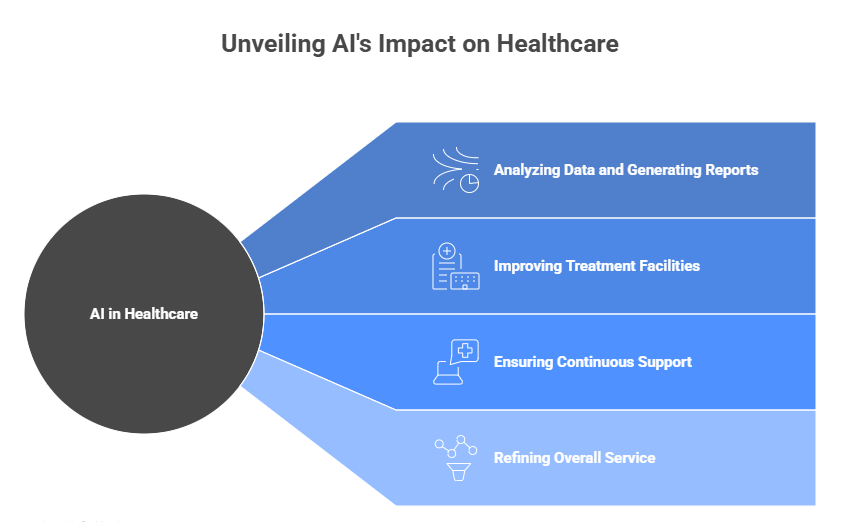
The following are the ways that highlight how AI in healthcare is revolutionizing operations and enhancing efficiency –
- Analyzing Data and Generating Reports: AI tools procure data from multiple sources like prescriptions, bills, lab reports, medical imaging, patient histories, etc., and analyze them. After analysis, these tools provide real-time reports that help healthcare professionals make decisions regarding giving reminders to patients, appointments, etc.
- Improving Treatment Facilities: AI in healthcare facilitates deep data analysis, predictive insights, and data-driven decision-making to ensure that the diagnosis is accurate. This allows healthcare professionals, particularly doctors, to detect diseases early, figure out risks for patients, and make tailored treatment plans.
- Ensuring Continuous Support: AI systems are active 24×7 and can handle too many queries at a time. This is how patients can address their basic queries using AI chatbots even when healthcare professionals are not available. These applications highlight AI healthcare trends enabling medical care to be more prompt and data-driven.
- Refining Overall Service: AI in healthcare simplifies administrative work by automating tasks like scheduling appointments, managing documents, generating reports, etc. This reduces errors and lets healthcare professionals spend more time caring for patients, which improves overall service and patient experience.
Also Read: AI Implementation Made Easy: 7 Smart Steps to Scale Your Business
Challenges of AI in healthcare and how to overcome them
Being a caregiving industry dealing with vulnerabilities and crises all the time, the healthcare industry is overwhelmed with pressure and demand. The healthcare industry is also skeptical of the challenges of AI in healthcare due to a vast number of scattered datasets, biases, quality checks, etc.
| Common Challenges | Their Consequences | How Bloom can help in resolving the challenges |
| 1. Data Breaches and Trust issues | The healthcare sector deals with large amounts of sensitive data like patient histories, bills, doctors’ data, etc. So, if security is weak, this can result in data breaches, regulatory penalties, and make patients lose trust. | Bloom uses Azure’s security, compliance, and monitoring tools to keep business and customer data safe. By ensuring responsible AI usage and leveraging encryption and access controls, Bloom helps organizations lower the risk of data breaches and gain trust. |
| 2. Biasness and Ineffective Treatment | If AI in healthcare is trained on incomplete data, it can produce flawed results. This may cause inaccurate diagnoses, poor assessments, and ineffective treatment plans for patients. | Bloom creates custom Azure AI infrastructure and machine learning models with tested data to help reduce bias. Bloom ensures regular checks and updates its models to keep AI results accurate, reliable, and relevant to business and user needs. |
| 3. Operational Disruptions | If AI is not properly integrated within the existing systems, it can disrupt clinical workflows and make administrative tasks more complicated. This will ultimately lead to operational inefficiency. | Bloom securely connects Azure AI solutions with your current systems to keep workflows smooth. By automating tasks like scheduling, data entry and processing, and documentation, Bloom ensures that operations are optimized. This boosts productivity up to the optimum level. |
| 4. Compliance Risks | When regulations are unclear and not properly defined, legal and compliance risks can arise. This can slow down AI initiatives and stop healthcare organizations from accessing the full benefits of AI. | Bloom makes sure its AI solutions follow industry rules and Azure’s governance standards. It offers built-in compliance tools that help businesses reduce legal risks and keep decision-making transparent and accountable. |
| 5. Missed Opportunities for Preventive Care | If healthcare organizations don’t make use of advanced applications and rely on manual processes, this can affect the entire process. This will slow down diagnosis, increase costs, and cause missed opportunities for early disease detection and prevention. | By leveraging Azure AI Foundry, predictive analytics, and meaningful insights, Bloom helps organizations detect risks early and take action ahead of time. This further helps in analyzing strategies and maximizing long-term value. |
| 6. Inadequate Training | If healthcare staff are not properly trained on AI systems, they will have trouble understanding AI usage. This can impact patient care and result in faulty operations. | Bloom offers thorough guidance on AI adoption and continuous support to teams. With proper communication, training, and ongoing support, Bloom helps your teams use AI systems effectively and confidently and achieve desired results. |
Turn healthcare AI challenges into opportunities with expert-led AI Development Services designed for secure, compliant, and scalable innovation.
The Benefits of Using AI in Healthcare
From analyzing huge medical datasets, automating administrative tasks to enabling patient monitoring, AI helps healthcare professionals in many ways. The benefits of AI in healthcare go beyond using a few tools or software; they are directly related to improving patients’ outcomes, bringing value, and operational efficiency.
1. Accurate Diagnostic Care and Clinical Methods
AI in healthcare can promptly review large amounts of medical data, like patients’ histories, doctors’ files, lab results, bills, X-ray reports, CT scans, MRIs, etc., and offer insights. It can quickly detect issues and anomalies that the human eye might miss. This leads to faster and more accurate results. When problems come to attention early, healthcare providers can act sooner, which improves treatment facilities and helps in preventing disease.
2. Patient Monitoring and Personalized Care
As more people, like the elderly or post-surgery patients, need remote patient monitoring, the use of AI in healthcare further strengthens. AI-powered systems, being trained on patients’ data, offer real-time updates on their health, activities, etc. This is helpful for healthcare professionals to monitor them and offer relevant advice. This also allows healthcare professionals to give reminders, schedule appointments, etc. This helps healthcare professionals create tailored care plans.
3. Faster Workflows and Reduced Administrative Burden
AI can effectively automate routine tasks like data entry, scheduling, and data analysis and processing, which saves time on repetitive administrative work. This makes things run more smoothly, reduces errors, and allows healthcare staff to spend more time with patients.
4. Prior Clinical Decisions
AI tools and techniques help healthcare professionals by analyzing vast datasets and giving them data-backed insights. This further lays out the foundation for early diagnosis, offering advice and creating treatment plans. This is how AI in healthcare helps in making confident decisions and ensures care is consistent and based on real-time results.
5. Cost Reduction and Better Outcomes
AI initiatives help in reducing expenses by making workflows faster and smoother, reducing inefficiencies and errors in diagnosis. AI in healthcare is also useful in cutting down on unnecessary procedures like hospital readmissions, repetitive tests for diagnosis, etc. This not only helps in cutting expenses but also enhances patients’ experience and increases trust in medical care.
6. Improved Accessibility
AI-enabled monitoring and real-time updates make it easier for patients to access medical services. AI systems are active round-the-clock, trained on vast amounts of data, and share real-time updates. This also helps patients get basic information on health issues immediately, even when the healthcare professionals are busy or not available. This helps them get timely care while keeping diagnoses and treatment accurate.
Build Smarter Healthcare AI Solutions

Real-World Examples of AI in Healthcare
AI in healthcare is changing the way medical services are delivered to people everywhere. The following AI in healthcare examples highlight improved patient experiences, optimized operations, and many innovative approaches.
- AI Chatbots and Real-time Feedback: AI chatbots are always available to help patients at any time. They answer questions instantly and give real-time feedback tailored to each person. This makes healthcare more accessible and reliable to patients.
- Predictive Analytics for Assessing Risks: AI systems gather and analyze data to provide useful insights. These insights help predict which patients might need to be readmitted, could have complications, or need urgent care. This helps doctors step in earlier and provide immediate care.
- Personalized Care and Treatment Plans: AI tools look at patient data and offer reports in real-time. This helps the healthcare staff to offer treatment plans tailored to each person in the way they need. With AI in healthcare, the staff can also track how patients respond and adjust treatments.
- Evidence-based Results: AI systems analyze patients’ data and help doctors make decisions and curate plans early. This reduces the possibilities of mistakes in treatment plans and enables healthy medical practices. This also increases the trust of patients in healthcare systems.
- Innovations and Developments: AI in healthcare helps medical experts research with precision and come up with valuable results. This further facilitates new medicine discovery, assesses new procedures, and runs clinical trials with confidence. This helps in upgrading existing treatment plans and coming forward with new ones.
The Growth of AI in Healthcare
By implementing AI systems, the healthcare industry is evolving and learning to handle more complex needs. The growing adoption of AI in healthcare is making the sector smarter, agile, and able to offer more than what is expected of its users. Here are some important highlights to justify this growth.
- Robot-assisted surgery had the biggest share of the market in 2024. More chronic conditions and a greater need for minimally invasive procedures strengthened this growth. Patients were found to heal faster and get better results with these surgeries. AI also makes surgeries more accurate, faster, and easier to perform. (Fortune Business Insights)
- In 2024, the U.S. had a big share of the North American market. This is because AI-based technologies were widely used in medical imaging and diagnostics, patient monitoring, and hospital management systems. (Fortune Business Insights)
- AI-oriented digital health companies got 42% of all digital health funding in 2024. This is a leap from the 7% they got in 2015. (Statista)
Conclusion
In simple words, the adoption of AI in healthcare is meant to serve two major aspects. To begin with, meeting patients’ expectations to make their experience better. Second, helping healthcare workers do their jobs and spending more time with patients. The future of AI in healthcare will determine how healthcare workers work together to improve care instead of replacing human workers.
AI systems will empower medical experts and professionals by offering data-driven insights and reducing unnecessary manual work. Over time, it can be expected that AI technology will introduce more advanced initiatives to close gaps in care.
Are you looking for AI solutions that reduce workload and also improve patients’ experiences? Let’s talk to get started.
Frequently Asked Questions
Q1. What is AI in healthcare?
AI in healthcare means using software systems like machine learning, natural language processing, and deep data analysis. This is very useful for healthcare workers to organize medical data, make better choices, and do their administrative work without any problems. AI also helps with making treatment plans that are unique to each patient, catching illnesses early with real-time feedback, and keeping operations running smoothly.
Q2. Will AI revolutionize healthcare?
AI is already redefining healthcare by automating tasks, giving real-time updates, sharing feedback, and more. It is expected that healthcare will flourish further with AI and become more accurate, efficient, and easily accessible. AI will assist healthcare experts and professionals in personalizing treatment plans for patients, enabling proactive care, identifying patients with risks, and reducing readmissions. When repetitive tasks are automated by AI systems, healthcare professionals can spend more time attending to patients.
Q3. How can AI improve patient care?
AI tools and techniques can help healthcare professionals take better care of patients by detecting diseases early through real-time feedback and planning medical care that is unique to each patient. With AI, healthcare professionals can monitor patients’ data and make better decisions more promptly. This allows healthcare providers to attend to patients more patiently and meet their expectations.
Q4. What is the global AI in healthcare market size?
In 2024, the global market for AI in healthcare was recorded at $29.01 billion. It is expected to expand from $39.25 billion in 2025 to $504.17 billion by 2032. This growth clearly indicates that the CAGR will be 44.0% during the mentioned period.
Q5. Which segment accounted for the largest share of AI in healthcare?
The AI technology is further divided into certain sections, namely machine learning, context-oriented phases, natural language processing, generative systems, vision, and image analysis. Among all of these, the machine learning part in the healthcare market had the biggest share in 2024.
Q6. How Artificial Intelligence has impacted the healthcare industry?
The AI technology has updated and changed the healthcare sector by analyzing data, gathering insights, and sharing real-time feedback. These further improved diagnoses, helped in personalizing treatments for every patient, and made it possible to identify diseases early. It automates administrative tasks, allows for monitoring, and facilitates better decision-making. This made care-giving more efficient and accessible. Also, it subsided the pressure on healthcare staff.
Q7. Is AI the future of healthcare?
With the widespread adoption of AI technologies in healthcare, it can be said that the future of healthcare will be dominated by AI. With its ability to analyze data and share real-time insights, it helps healthcare professionals make better decisions, improve patient outcomes, and deliver care more efficiently. It also allows for innovative outcomes with advanced research, medicine discovery, and many more. As healthcare systems put more emphasis on accessibility and preventive care, AI’s impact will continue to flourish.
Q8. Is AI ready for healthcare?
While AI is already delivering positive outcomes in the healthcare sector, the question, whether it is ready for the sector or not depends on various factors. AI in healthcare is enhancing diagnostics, monitoring, and clinical methods. But for AI to work flawlessly, healthcare staff need to be well-trained and understand how to use AI systems and techniques. The staff also needs to follow all compliance and regulatory rules to ensure responsible AI usage. All of these can ensure smooth AI implementation.
Q9. Is AI in healthcare a good investment?
AI technology in healthcare is indeed a good investment because it eases operations and reduces significant pressure on healthcare workers. AI systems can analyze vast datasets, automate operations, lower costs, and improve overall service delivery. When it is integrated with existing systems smoothly and functions in line with the organization’s needs, it ca The Growth of Artificial Intelligence (AI) in Healthcare n ensure better ROI. By responsibly using AI, speeding up processes, and improving decision-making it allows the healthcare sector to stay competitive.
Table of Contents
Schedule A Free Call Now !
Fill Out the Form and Our Experts Will Contact You Within 24 Hrs
Recent Posts
- Why Your AWS Bill Increased After Migration (And How to Fix It Fast)
- Best AWS Cloud Management Tools to Simplify Cloud Operations
- AWS Consulting Partner vs In-House Cloud Teams: What Businesses Should Consider
- AWS Migration Checklist: What Businesses Should Prepare Before Migrating Applications
- Key DevOps Best Practices for Applications Running on AWS