What Is Microsoft AI Foundry and How Does It Work?
Software development in the digital realm today is undergoing drastic changes. AI-powered technologies can now turn ideas into prototypes and workable solutions in hours instead of months of planning and implementation. For conducting this, businesses need an end-to-end unified environment that accommodates development, deployment, and governance seamlessly. This is why Microsoft AI Foundry is widely chosen by businesses today. It runs on Azure’s integrated ecosystem and is a part of the larger Microsoft AI platform.
So far, it has served more than 70,000 customers and processed 100+ trillion tokens per quarter. Besides, it facilitates around 2 billion corporate search queries every day.
Table of Contents
What is Microsoft AI Foundry?
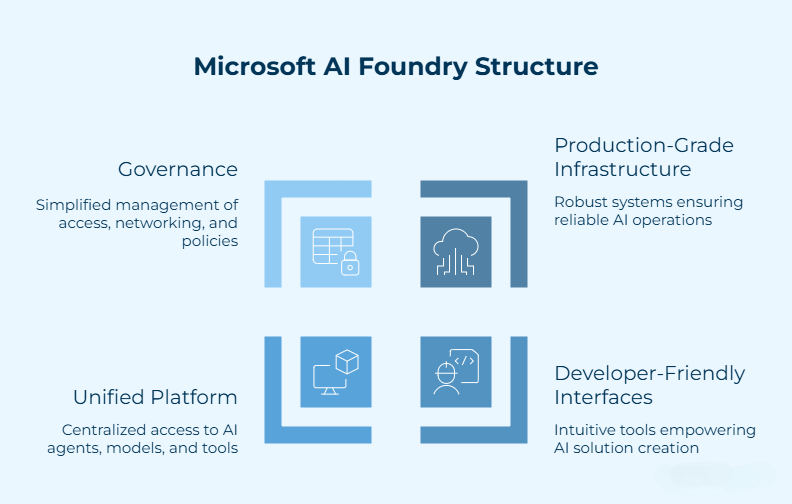
Microsoft AI Foundry is a centralized platform-as-a-service that allows businesses to manage AI operations, construct models, and move from pilots to complete AI applications. It has production-grade infrastructure and developer-friendly interfaces. This enables teams to concentrate on creating AI-powered solutions instead of taking care of the systems that run them. It’s an enterprise AI platform consisting of agents, models, and tools in one place. Teams can monitor, trace, test, and configure systems on a single platform for business needs. Unified and role-oriented access control, networking, and policy management under one provider make governance easier.
It’s worth mentioning that Azure AI Foundry has been repositioned under the Microsoft AI Foundry to better reflect its role in the enterprise AI ecosystem.
Features of Microsoft AI Foundry
Microsoft AI Foundry enables businesses to easily develop and use enterprise-grade AI solutions on their current cloud infrastructure. Let’s understand the platform by analyzing its features.
- A diverse range of models: You can get access to more than 11,000 foundational, open, logical, multimodal, and industry-specific models. Besides, you get tools to test and compare models for your unique business needs.
- Flexible Customization and optimizable capabilities: Train, fine-tune, compress, and automatically upgrade models using as little coding as possible to improve performance while keeping operational expenses reasonable.
- Smart model routing for better efficiency: Automatically send AI requests to the best model in real time to get the maximum value while lowering costs and improving overall performance.
- Security and governance aligned with business needs: Set up a strong identity, access, and enable role-based permissions. This allows you to see how data is being utilized, what users are doing, and what threats applications expose at all times.
- Responsible AI usage and compliance: Protect sensitive data in prompts and AI-generated outputs, mitigate against vulnerabilities like prompt injection. You can also use governance controls that abide by regulatory and responsible AI standards.
- Made for AI platforms in the cloud: Operates as a cloud-first, scalable base that lets businesses safely install and manage AI workloads throughout the entire organization.
Read Also: Top 7 Azure AI Foundry Features Every Enterprise Should Know
How Microsoft AI Foundry works?
The Microsoft AI Foundry architecture is a modular and production-ready framework that unifies data, multiple models, performance, and governance into one system.
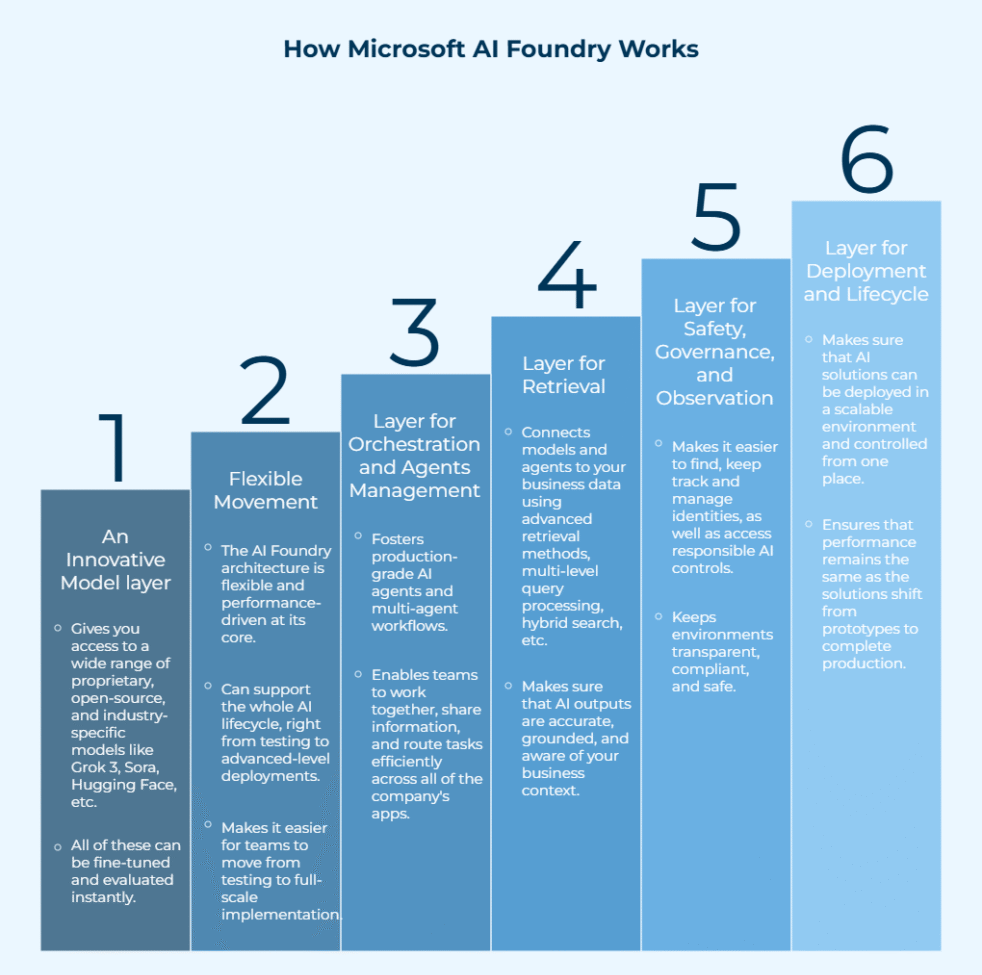
- An Innovative Model layer: It gives you access to a wide range of proprietary, open-source, and industry-specific models like Grok 3, Sora, Hugging Face, etc. All of these can be fine-tuned and evaluated instantly.
- Flexible Movement: The AI Foundry architecture is flexible and performance-driven at its core. This is because it can support the whole AI lifecycle, right from testing to advanced-level deployments. This makes it easier for teams to move from testing to full-scale implementation.
- Layer for Orchestration and Agents Management: It fosters production-grade AI agents and multi-agent workflows. This enables teams to work together, share information, and route tasks efficiently across all of the company’s apps.
- Layer for Retrieval: It connects models and agents to your business data using advanced retrieval methods, multi-level query processing, hybrid search, etc. This makes sure that AI outputs are accurate, grounded, and aware of your business context.
- Layer for Safety, Governance, and Observation: This layer makes it easier to find, keep track and manage identities, as well as access responsible AI controls. This keeps environments transparent, compliant, and safe.
- Layer for Deployment and Lifecycle: This layer makes sure that AI solutions can be deployed in a scalable environment and controlled from one place. It also ensures that performance remains the same as the solutions shift from prototypes to complete production.
This ensures flexibility, scalability, and performance that meet the unique demands of your business. This is how is Microsoft AI Foundry architecture explained.
Let us help you try Microsoft AI Foundry for your AI initiatives!
Build and Scale Intelligent Solutions with Microsoft AI Foundry Consulting

Microsoft AI Foundry Use Cases
Businesses now look for AI solutions that can scale with their needs and make a real difference. The Microsoft AI Foundry ensures businesses can use advanced AI systems in their operations. The use cases justify this.
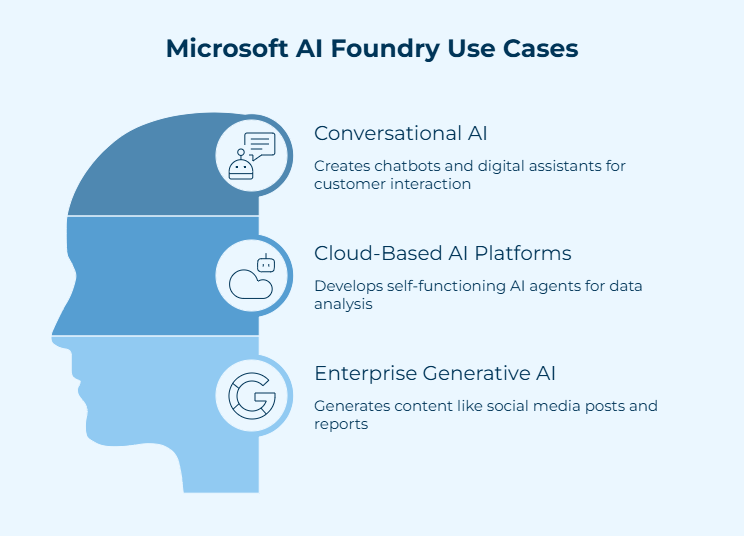
- Conversational AI and Interactive assistants: You can create chatbots and digital assistants and train them on the company’s vast data to make them aware of their surroundings. They can answer customer queries in real-time, generate bills for them, and connect to a human agent for complex queries.
- Cloud-Based AI Platforms: You can develop AI agents that function on their own. Like, they can gather data, make decisions in real-time, and generate valuable insights. These agents can share customized feedback to improve workflow and provide valuable information about the ongoing operations.
- Enterprise Generative AI for Making Content: You can use generative AI to create content like unique social media posts, workreports, specific designs, personalized email content, etc. Clean and refined data ensure that the outputs match the brand’s tone and cater to the demands of their audience.
Businesses can use the AI Foundry platform across their departments seamlessly to improve efficiency, drive innovation, and create high-impact value.
Read Also: 10 Best Azure AI Foundry Use Cases Across Industries in 2026
Conclusion
Microsoft AI Foundry is indeed redefining the way businesses develop AI initiatives, replacing fragments within the development cycle. It makes the whole process from experimentation to full-scale production development easier. In the Microsoft AI Foundry vs traditional AI development comparison, the former wins because it delivers innovation through Foundry Labs and Microsoft Research. Project Amelie is one compelling example of this innovation. It is an autonomous agent that can create full machine learning pipelines from a single prompt. Hence, it is expected that Microsoft AI Foundry will continue to evolve and help businesses explore new opportunities.
Are you working on a new AI project? Explore how Microsoft AI Foundry turns ideas into solutions that bring results. Let’s connect!
Frequently Asked Questions
Q1: What is Azure AI Foundry?
Azure AI Foundry is an AI platform that works with other platforms. It lets you create, launch, and expand AI apps and agents however you want. It provides security, governance, and growth for businesses of all sizes. You can conduct experiments and run different operations on the same platform as well.
Q2: What is Microsoft Foundry and Azure?
Microsoft AI Foundry is the space where you can get models, agents, and tools for building solutions in one place. It gives developers the tools they need to create complex AI solutions quickly and lets businesses have full control from start to finish. It also ensures visibility throughout the AI lifecycle. This makes it easier to deliver AI applications that understand the context and have a positive impact on the business.
Q3: How does Azure AI Foundry work?
Azure AI Foundry helps organizations pick, tweak, and use AI models that work in the Azure cloud. There are a lot of different models that developers can choose from. They can change them for certain reasons and then put them all in one place for apps. The platform takes care of infrastructure, orchestration, tracking, and governance. This lets teams quickly go from testing to full production while making sure the system can expand and work well.
Q4: What is Azure Arc and Foundry?
Azure Arc lets you manage and use Azure services in on-premises, edge, and multi-cloud settings. Organizations can now manage, monitor, and update both on-device AI deployments and cloud-based workloads from one place. This has been possible because Azure Arc and Foundry are now working together. This lets you consistently manage the lifecycle, configuration, and governance of AI models and agents, even when they aren’t running in the Azure cloud.
Q5: How can Microsoft AI help your business?
Microsoft AI helps organizations use advanced AI capabilities in their business settings. Organizations can customize AI to fit their needs by using thousands of models and fine-tuning tools within the platform. It makes routine tasks easier, reduces unnecessary manual labor, and makes operations run more smoothly. Microsoft AI also comes with an integrated development environment that lets developers try, deploy, and manage solutions without any disruptions while keeping security intact.
Q6: What is a unified and interoperable AI platform?
Microsoft AI Foundry is a unified and interoperable AI platform. It brings together different AI technologies like machine learning, natural language processing, and generative AI into one system. This makes it easier to develop, deploy, and manage enterprise-ready AI solutions because it lets elements work together without any issues.
Q7: What will Microsoft do with AI in 2026?
In 2026, Microsoft aims to work for the betterment of society at large using AI capabilities. Microsoft AI Foundry and other AI services will be built into cloud, productivity, and security platforms extensively. The tech giant also aims to create significant developments in specific fields like healthcare. To put it simply, Microsoft wants AI to be a big part of how businesses operate, deliver results, and protect their environments.
Q8: What AI features are available in Microsoft Teams?
Microsoft Teams has a lot of AI features that are meant to impact working positively, getting things done, and improving the overall user experience. Some of these features are Microsoft Copilot for smart responses, voice isolation for clearer calls, video optimization, real-time translation, live captions, and smart media quality classifiers. These AI features work together to help teams coordinate, focus, and keep working seamlessly.
Q9: What services does Azure AI Foundry support?
Azure AI Foundry offers a wide range of services to help businesses develop AI. Companies can use generative AI apps, browse a vast library of AI models, and work together in development environments. AI Foundry also upholds security and strong governance. These benefits of Microsoft AI Foundry allow businesses to quickly build, deploy, and manage AI solutions, expand their operations, and monitor their workflow.
Q10: How can I use Azure AI Foundry as service endpoints?
Sharing your AI models and agents through APIs allows you to use Azure AI Foundry as a service endpoint. This is how apps, internal systems, or third-party services can use features like generative AI, intelligent search, or workflow automation in real time without any issues. It also ensures that you don’t have to worry about managing the infrastructure.


Recent Posts
- Azure Cloud Architecture Explained: A Simple Guide for Enterprises
- CI/CD Pipeline Setup in Azure: Best Practices for 2026
- DevOps vs DevSecOps: What’s the Difference?
- Hire Azure DevOps Developers Who Deliver Faster, Secure CI/CD Pipelines
- Azure Virtual Machines vs Containers: What’s Right for Your Infrastructure?