Top Mistakes to Avoid When Hiring AI Engineers
Unprecedented advancements in terms of AI and the increasing emphasis on hiring AI engineers is reshaping various sectors of the industry. With the help of Artificial Intelligence engineers, a company can achieve high efficiency with record levels of innovation. The biggest issue that one may experience when it comes to scaling AI engineers within one’s organization is finding the right talent. Many organizations make common mistakes.
From ignoring the strategic direction of the AI engineer to failing to set and communicate clear expectations and overlooking the significant AI engineering roles, this can lead to wasted resources, missed project opportunities, and AI solutions that fail to deliver results.
Understanding the pitfalls large numbers of businesses make and the benefits related to having the right skill set are the first steps towards enlightenment and executing an informed hiring decision. Partnership with professional hiring solutions providers, such as Bloom, helps in making that effort worthwhile.
If you are looking for AI engineer recruitment tips, this blog has everything covered.
Table of Contents
Common Mistakes Companies Make When Hiring AI Engineers
Hiring AI engineers is one of the most critical tasks involved in embarking on AI-driven initiatives. Taking time to read through is worthwhile when many companies face these problems due to constant repetition, and then they end up wasting time, having poor project outcomes, and high turnover.
The most common AI engineer hiring mistakes companies make are:
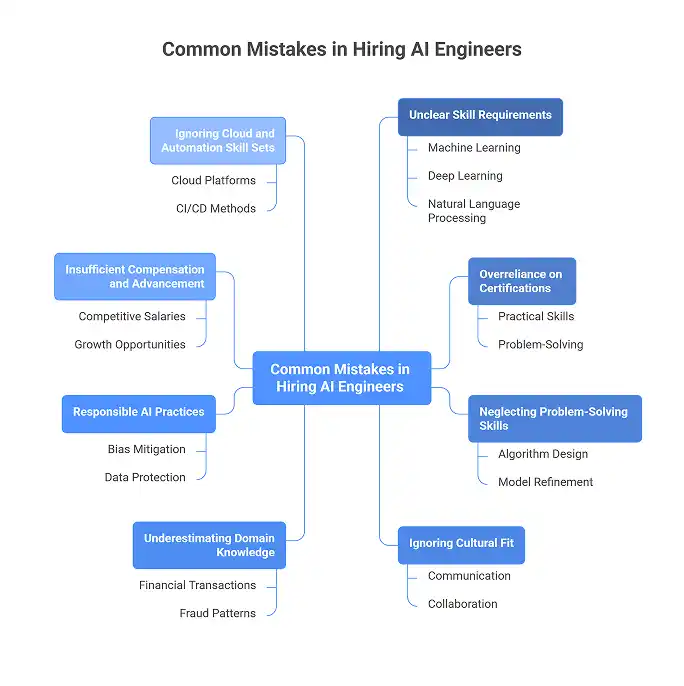
Unclear Skill Requirements
A huge mistake that companies make while hiring AI engineers is the failure to specify in detail what skills are needed. AI encompasses various facets in itself, such as machine learning, deep learning, natural language processing, and cloud deployment. Hiring without clarity will result in candidates who are technically competent yet are disconnected from the business aims, thereby causing delays in project execution.
Overreliance on Certifications
Although certifications reflect learning while hiring AI engineers, they are not guaranteed practical skills. By depending merely on certifications while hiring, companies attract engineers who have only the mindset to pass exams, but not the will to practically solve a problem or implement AI solutions hands-on.
Neglecting Problem-Solving Skills
Coding and technical tests are well-known, but they are unable to predict an engineer’s way of solving intricate business challenges. To solve optimally, the top AI engineers must understand designing algorithms, refining the models to solve them, and troubleshooting in real-world, dynamic scenarios. Failing to assess this skill would result in late solutions and increased project costs.
Ignoring Cultural Fit
Engineering collaboration for effective communication within teams is often dismissed. Even the most skilled AI professionals may very well underperform if they do not adapt to the company culture, inform stakeholders, or work cross-functionally.
Underestimating Domain Knowledge
The lack of operational knowledge can significantly impact the effectiveness of the resulting solution, especially when hiring AI engineers without sufficient domain understanding. An engineer may build AI models that appear to address the right problems while still introducing errors. This often leads to a solution approach that is technically correct but practically impractical due to insufficient domain expertise.
Responsible AI Practices
Responsible AI practices are crucial for ensuring compliance and trust. Disregarding biases, model transparency, and data protection will put companies at a higher risk of violating regulations. Legal and reputational damage may follow. Engineers should be well-versed in the principles of ethical AI.
Insufficient Compensation and Advancement
The demand for AI engineers is huge. Employers daily miss out on the opportunity to hire top talent to their competitors by offering non-competitive salaries or failing to provide avenues for growth. Working on projects and having the potential to advance and learn are just as significant as decent engineer salaries.
Ignoring Cloud and Automation Skill Sets
Today’s and tomorrow’s AI solutions are heavily reliant on cloud platforms, automated pipelines, and CI/CD methods, making hiring AI engineers with these capabilities essential. Engineers lacking these skills might be able to engineer models, but such models are extremely difficult to deploy, scale, and maintain, driving inefficiencies and high operational costs.
Not Having Interdepartmental Collaboration Skills
AI projects demand collaboration among data scientists, engineers, and business teams. Projects delayed by engineers who are unable to articulate their needs or cooperate with various departments may not have the desired end-user requirements.
What Are the Benefits of Hiring AI Engineers?
One of the most important parameters for successful business transformation and gaining value is to have the right AI talent. Able to write algorithms and develop models, talented AI engineers ensure that the solutions work according to the strategy and operational goals of the organization, provide efficiency, and unlock new possibilities.
Read More : The Role of AI in the Future
Faster Time to Resolution – Experienced AI engineering professionals can quickly identify a problem, create a plan, and identify tasks. The expertise also speeds up project timelines, cutting down on trial-and-error cycles by ensuring the timely delivery of AI solutions that meet the business objectives.
Better Usage of Data – Good AI runs on good data, which is why hiring AI engineers with advanced analytical skills is critical. It would be excellent to identify engineers capable of working on data cleaning, preprocessing, and large-scale data understanding, as they can derive actionable insights to support diverse decision-making from an organizational perspective, enable business process optimization, and, above all, enhance existing models to identify and realize hidden opportunities.
Scalable Solutions – Businesses and their data and AI need to grow. Properly trained engineers develop models and systems that are scalable and do not need frequent redesigns or costly reimplementation. Scalable solutions ensure the longevity and futureproofing of AI investments.
Creativity and Innovation – Hiring AI engineers bring limitless creativity and problem-solving capabilities. They can think of novel approaches, combine several AI techniques, and experiment with new algorithms to address business challenges in unique, innovative ways. This can give companies a competitive advantage.
Compliance and Ethical Assurance – Engineers knowledgeable in ethical AI ensure that the solutions are ethical, unbiased, and compliant with all laws and regulations. This reduces legal risks, protects brand reputation, and builds trust with customers and various stakeholders.
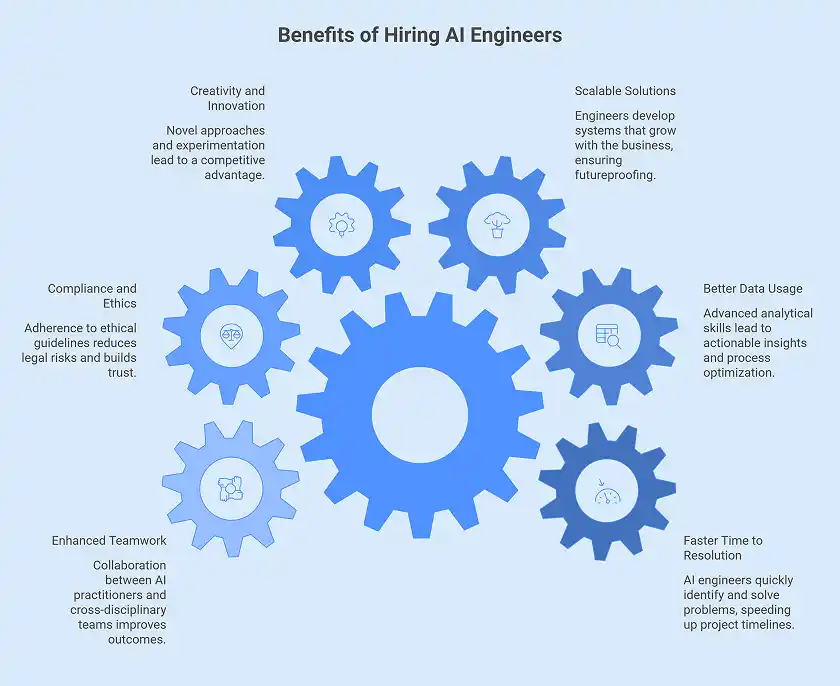
Hiring AI engineers ensures better teamwork between AI practitioners and cross-disciplinary professionals from the pool of developers, data scientists, and business stakeholders makes sure that the AI interventions manage to serve the strategic pain points of the organization. This support will lead to the success of the AI scope business initiatives, better outcomes, smoother project rollouts, and higher effective adoption.
Right Ways to Hire AI Engineers
Before You Start: Define What You Actually Need
Before hiring AI engineers, it is essential to specify and delineate your AI expectations. Do not hesitate to state in detail the competencies needed, say natural language processing, computer vision, or recommendation systems, and the business outcomes the engineer is supposed to deliver.
A good job description should not be limited to AI engineer skills. It should describe the challenges that the engineer is going to be solving, the technology stack they will be working with, how the team will be interacting, opportunities for growth, and open salary ranges to lure the right talent.
Where to Find Qualified AI Engineers
The process of hiring AI engineers requires a mix of general and specialized talent sources. An extensive talent pool is offered by well-known platforms such as LinkedIn, GitHub, Kaggle, Upwork, and Toptal.
Moreover, AI-targeted job boards, recruitment agencies, university AI labs, industry seminars and conferences, and hackathons are some of the ways through which hiring AI engineers can become easier. Additionally, employee referrals still count as one of the most trustworthy and premium ways to spot quality talent.
How to Evaluate AI Engineering Talent Effectively
Evaluation should not be limited to resumes but should highlight real-world capabilities. Practical coding assessments, reviews of GitHub portfolios, and detailed discussions around past projects all help assess how candidates manage the transition from training to production.
It is also crucial to verify practical experience with core frameworks and tools like Python, R, TensorFlow, PyTorch, and LangChain when hiring AI engineers. Besides technical skills, assess the ability to solve problems, communicate, collaborate, adapt, and be aware of ethical AI practices like fairness and transparency.
Look Beyond Resumes and Certifications
A resume alone can hardly show an AI engineer’s full potential. Give preference to portfolios, open-source contributions, published research, real case studies, and demonstrations of deployed systems. These signs give a better view of how candidates cope with real-world AI problems.
Choose the Right Hiring Model
Varied business requirements necessitate distinct recruitment methods. For brief or expert tasks, freelancers or contractors are the best fit. AI firms grant instant access to qualified and ready-to-deploy talent, thus reducing hiring risks.
Organizations are now hiring AI engineers from India, which brings the benefits of cost efficiency and scalability while maintaining quality, thanks to the use of remote and global talent models.
Get Expert Tips on Hiring AI Engineers!

How Can AI Engineers Give Businesses a Competitive Edge?
AI engineers play a crucial role in the tech spectrum. Their first job is to train and create new models. However, they also help the businesses that adopt AI to get the technology’s full benefits and, practically, that boils down to businesses acquiring a foothold in the market that is measurable through margins or revenue.
Operational Efficiency – One of the most significant impacts of hiring AI engineers is automation. They apply AI and machine learning algorithms to automate repetitive and time-consuming processes, thus resulting in fewer errors and faster processing of client requests. Human resources can then be allocated to higher-value activities, increasing productivity and even leading to a drop in operational costs due to increased efficiency.
Data-Driven Decisions – AI engineers can analyze complex datasets, leading to the extraction of actionable insights that can be used to determine the course of the business’s future. Such insights not only inform the company’s overall strategy but also impact decisions taken in resource allocation, the departments involved, and even the timing, making the business more responsive to market fluctuations.
Faster Time-to-Market – The proficient hands of engineers come to rapid design and rollout of AI solutions, which consequently leads to the quickening of the product development cycle. This means that companies are capable of launching new products faster than competitors and gaining the chance to capture market share earlier.
Enhanced Customer Experience – One of the major areas through which AI is impacting customer experience is personalization, where AI assists by suggesting relevant recommendations based on previous purchases or analyzing customer feedback through sentiment analysis, thus facilitating the creation of customized experiences that draw customers in, keep them satisfied, and encourage repeat engagement.
Strategic Innovation – AI engineers build the foundation for strategic growth by developing predictive models, automation pipelines, and smart tools that generate new revenue streams and business opportunities.
Cross-Functional Integration – AI engineers’ collaboration with product, operations, and business departments means that AI projects are not only important to the organization but also have smooth integration and high impact.
Why Choose Bloom for AI Engineer Hiring?
Hiring AI engineers can be a challenging process, but Bloom supports firms in overcoming this issue and avoiding typical hiring errors. Bloom employs a strict vetting process that guarantees not only technical and problem-solving skills but also compliance with ethical and responsible AI practices.
To provide expert knowledge for a specific field, Bloom links businesses to engineers who are aware of the nuances of the industry, which results in quicker onboarding and immediate contributions to projects.
The organized onboarding process guarantees that engineers will be integrated into teams without any issues, thus, productivity will be at its peak right from the first day. Also, engineers participate in continuous upskilling programs as they are kept informed about the latest developments in AI.
In addition, the global talent pool offers diverse perspectives and creative solutions. Businesses that choose Bloom as their partner can expect hiring AI engineers who are skilled, flexible, and visionary AI professionals who will not only lead strategic moves but also make operations more efficient and ultimately generate long-term value.
Conclusion
It is a strategic decision to hire AI engineers that affects the entire organization, from the innovation aspect, through operational efficiency, to long-term growth. The major challenges include not clearly defining the required skills, not assessing problem-solving abilities, and not considering culture and ethics. The right people can bring significant benefits, such as quicker organization of data and better use of it, more satisfied customers, and the launch of new products. AI engineers truly create competitive advantage by providing organizations with the possibility of making decisions based on data, automating some processes, and facilitating collaboration across departments.
Working with Bloom means that companies can avoid typical hiring mistakes, get expert and industry-ready engineers, and achieve long-term success. By fixing these areas in a smart way, companies can turn their AI projects into profitable initiatives and maintain a strong market position.
If you are looking forward to AI team building, you can visit us here.
Frequently Asked Questions
Q1. What are the most common mistakes when hiring AI engineers?
Most of the time, job descriptions are not clear, employer expectations are unrealistic, technical evaluations are insufficient, and business context is not clearly explained. Also, the assumption is made that AI engineers will be able to deliver results without having the right data, infrastructure, or support from other teams.
Q2. How to hire AI engineers successfully?
To successfully hire engineers of AI, it is essential to set explicit business goals first, then align skills with the level of the project, check candidates’ experience in implementing AI, and look for people who can collaborate effectively. Moreover, candidates should have access to scalable cloud databases and big data platforms.
Q3. What companies get wrong when hiring AI engineers?
Organizations frequently prioritize buzzwords over practical expertise, concentrate excessively on model accuracy, underestimate experimentation time, and require immediate return on investment without the aid of long-term AI development.
Q4. What are some of the AI engineer hiring best practices?
Some of the best practices recommended by experts are writing job descriptions tailored to specific roles, conducting practical tests, checking MLOps and deployment skills, bringing in senior technical leaders for interviews, and providing employees with continuous learning and upskilling opportunities.
Q5. What are the skills to look for when hiring AI engineers?
The primary competencies consist of solid machine learning fundamentals, practical experience with real datasets, familiarity with cloud and MLOps, Python and AI framework skills, and awareness of data protection and ethical AI practices.
Q6. How Do Artificial Intelligence Engineers Add Business Value?
Artificial Intelligence (AI) applications have reached a level of maturity where AI engineers turn data into intelligent systems that enhance overall productivity while reducing human involvement. AI-based decision-making is faster and more reliable throughout the organization.
Q7. How Are Machine Learning Engineers Different From Data Scientists?
As a general rule, Machine Learning engineers focus on production-ready models along with scalability and performance, whereas data scientists prioritize analysis, experimentation, and insight generation.
Q8. What Makes a High-Performing AI Team?
A high-performing AI team consists of people with diverse skills, such as AI engineering, machine learning, data engineering, and MLOps, with defined ownership and strong alignment with business goals.
Q9. How Should Companies Approach AI Workforce Pl
Forecasting future AI initiatives is the first step, identifying skill gaps early is the second step, and finally, hiring, upskilling, and partnerships should be combined to create an AI workforce plan that can scale efficiently.
Q10. How Does the AI Talent Shortage Impact Business Growth?
The shortage of AI experts hampers innovation, raises recruitment expenses, and delays AI implementation, making it difficult for companies to remain competitive in data-centric markets. Hiring AI engineers has become a must in today’s competitive environment.
Q11. When Is the Right Time to Hire an AI Engineer?
The ideal time for a business to hire an AI engineer is when it has clearly defined AI applications, good-quality data, and the support of proper infrastructure for model development and deployment.


Recent Posts
- Azure Cloud Architecture Explained: A Simple Guide for Enterprises
- CI/CD Pipeline Setup in Azure: Best Practices for 2026
- DevOps vs DevSecOps: What’s the Difference?
- Hire Azure DevOps Developers Who Deliver Faster, Secure CI/CD Pipelines
- Azure Virtual Machines vs Containers: What’s Right for Your Infrastructure?