How Expert Cloud Consultants Manage Risk in Large-Scale Cloud Initiatives?
Large-scale cloud initiatives that are correctly guided can yield the trifecta of flexibility, scalability, and long-term cost savings. But at the same time, if not properly guided, they may result in a high-risk scenario. It is at this point that expert cloud consultants become indispensable. Their main benefit to the organization is that they enable a transition from on-premises to the cloud with transparency, control, and security, while maintaining business objectives as a priority in every decision made.
The first step for a cloud consultant is to assess the current IT landscape in its entirety, along with applications and business needs. Based on this assessment, the consultant prepares a detailed migration plan that is both clear and gradual, which in turn reduces uncertainty and prevents last-minute surprises. The consultant designs cloud infrastructure that is secure, scalable, and dependable, ensuring that systems not only perform well initially but can also adapt to future business growth.
Security and compliance issues are addressed from the very beginning of the project. Expert cloud consultants define governance structures, access controls, data protection measures, and processes for continuous monitoring to ensure that unauthorized access to sensitive information is prevented and regulatory requirements are met. They also manage change effectively by supporting teams with training and step-by-step transition plans to minimize disruption.
Consultants help organizations stay within budget while reducing operational risk by migrating in phases, testing at every stage, and closely monitoring costs. The outcome is a more seamless cloud journey with predictable results, stronger security, and measurable business value.
In this blog, we will dive deeper into how expert cloud consultants play a major role in reducing risks in large-scale cloud initiatives.
Table of Contents
What are the Enterprise Cloud Transformation Risks?
The big cloud projects on a large scale attract many organizations, but also bring significant risks along with technical challenges that vary in nature and size. Besides, those risks can have effects on operations, finance, compliance, and even business continuity. The majority of them come from human errors, complex system architecture, and the shared responsibility model of cloud security; thus, it is very important for organizations to adopt a proactive, security-first strategy.
- Cloud environments see security misconfigurations as one of their major and preventable risk factors. Default settings, overly permissive access controls, or rushed deployments can lead to the exposure of sensitive data. Even a single misconfigured storage resource can end up making millions of records public accidentally, highlighting the need for proper configuration management. This is taken care of by expert cloud consultants.
- Data breaches and data loss are serious issues arising from cloud deployment. Storing large volumes of sensitive customer data in the cloud makes companies an increased target for cybercriminals. Data loss can occur due to several reasons, such as accidental deletion, system crashes, and unauthorized system takeovers used to encrypt data (ransomware). The lack of effective backup and recovery systems can turn such incidents into costly ones in terms of both financial loss and reputational damage. Engaging expert cloud consultants can help organizations implement robust strategies and safeguards to minimize these risks.
- Identity and Access Management (IAM) system vulnerabilities raise the risk even higher. Unsecured passwords, lack of multi-factor authentication, and failure to enforce the principle of least privilege can lead to unauthorized access, account takeover, and misuse of sensitive systems.
- Besides information and security issues, compliance and regulatory challenges represent another area/opportunity where enterprises run into. It is important for companies to meet with numerous guidelines and regulations in regard to data safety and usage that might include the GDPR, HIPAA, and PCI-DSS, among others. The use of multi-cloud resources injects a wider ambit of difficulty in enforcing proper governance and monitoring of data locations, thus making greater room for non-compliance and potential fines.
- Risks include the absence of scrutinizing control instigated by shadow IT, insecure APIs, and third-party loopholes; human faults and insider threats; and outages or downtimes owing to hardware breakdowns, cyber-attacks, or disasters. Expert cloud consultants can assist in identifying these vulnerabilities and implementing measures to reduce such risks effectively.
- For this reason, good security measures, ongoing vigilance, automated tools, and ongoing staff training are imperative. These dimensions contribute to risk mitigation, regulatory compliance, protection of sensitive data, and sustaining operational resiliency, thus making the company’s journey through the cloud more assured and successful.
Read more : How to Find the Right Cloud Service Provider?
Who are Expert Cloud Consultants?
Expert cloud consultants are IT professionals who help companies use, manage, and optimize cloud computing environments. They act as the bridge between complex technology and business objectives, guiding organizations through digital transformation. Their role includes designing cloud architectures, migrating applications and data, improving security, and optimizing costs to deliver measurable business value.
Areas of Expertise
Main Platforms: A deeper understanding of prominent present-day cloud players, ie., AWS, Microsoft Azure, and GCP.
Deployment Models: Profound expertise in deploying cloud in public, private, and hybrid modes for each organization.
Servicing Models: Mastery in the infrastructure, like IaaS, the middle layer of PaaS applications, and finally SaaS.
Who Benefits from Expert Cloud Consultants?
- Enterprises engaged in digital transformation are organizations looking to upgrade existing systems and implement new technology solutions.
- Businesses seek to enhance efficiency, scalability, and reduce IT costs by driving optimized cloud adoption with the guidance of expert cloud consultants.
- Companies face complex cloud challenges that demand specialized knowledge to handle multi-cloud strategies, AI integration, and industry-specific solutions.
Consultants for cloud arrangements are equivalent to experts in the cloud computing domain. Through technical expertise and strategic insight into cloud computing, expert cloud consultants help organizations take full advantage of cloud services to build modern, stable, and cost-effective business environments. As a result, they are in high demand in scenarios where real-time business growth and scalability are required.
Contact Bloom Consulting for Expert Cloud Solutions!

What are the Key Services They Offer?
Expert cloud consultants help companies by guiding them through cloud adoption, migration, and optimization, creating solutions that are secure, cost-efficient, and scalable. They breathe new life into IT environments where automation and AI can play a role by providing a sense of ongoing support in their customers’ journey towards agility, cost savings, and long-term digital transformation. Here are the key cloud transformation consulting offerings:
Cloud Strategy & Consulting
This service involves the assessment of the current IT environment, including the infrastructure, applications, and workflows, while considering technical gaps and business needs. Expert cloud consultants design scalable and secure architectures. They define a technical roadmap for cloud adoption, typically establishing alignment with long-term business goals and minimizing risk and complexity.
Cloud Migration
Cloud migration is the process by which plans are laid down, and, ultimately, real movement involves existing physical infrastructures, applications, and data from on-premises or legacy systems shifted to the cloud. Among all objectives, lesser downtime, maintenance of data integrity, and maintaining application performance need to be looked at closely. The cloud implementation services approach relies on thorough governance to ensure that the systems run during the change.
DevOps & Automation
This field is largely dedicated to improving the software delivery cycle by way of CI/CD pipelines, Infrastructure as Code, and embracing modern application strategies such as microservices. Automation has a host of benefits: for one, it decreases experienced errors, which can increase the speed of release cycles, an aspiration sometimes absent in manual transactions. In addition, it maintains consistency in the environment so that updates are deployed more efficiently and reliably with little intervention from the team. Expert cloud consultants play a key role in implementing these automation practices effectively.
Security & Compliance in the cloud
Security services in the cloud strengthen overall security defense with governance controls, identity and access management, data protection, and compliance initiatives; from inception, DevSecOps allows security to be built into the fabric of development and operations, maintaining continual protection and ensuring adherence to regulatory requirements.
AI and Data Integration
These are services through which organizations can create smart, data-centric cloud solutions that integrate analytics, AI models, and data storage. These provide actionable recommendations to companies, inform decision-making, and unlock greater business value from data, with the guidance of expert cloud consultants.
Managed cloud Services
These services cater to continuous monitoring, consistent maintenance, and effective optimization opportunities across various cloud service models, including IaaS, PaaS, and SaaS, ensuring uncompromised functionality, availability, and ongoing improvement.
Cost Optimization
Cloud cost optimization focuses on reducing unnecessary cloud spending through resource right-sizing, usage monitoring, and efficient workload management to help organizations achieve full ROI.
How Expert Cloud Consultants Reduce Risk?
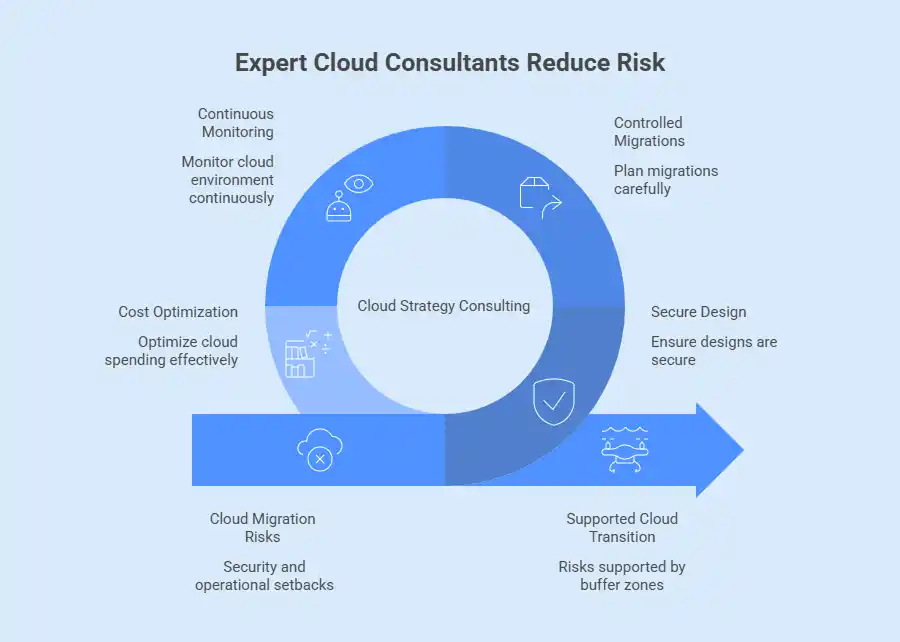
The mitigation of cloud security and operational risks effectively complements cloud benefits. However, with the right controls, the setbacks can be adequately cushioned. Consultants come into play in such cases, reducing risks through a well-thought-out cloud strategy consulting, ensuring designs are secure from the outset, planning controlled migrations, and ensuring continuous monitoring with a clear focus on cost optimization. Relief is experienced when moving to the cloud, with the assurance that risks are supported by sufficient buffer zones.
| Risk Category | Consultant Focus | Business Impact |
| Security & Compliance | Secure fit-for-purpose design, identity management, encryption, and continuous monitoring | Mitigates breach risk, safeguards sensitive data, and ensures regulatory compliance from the outset |
| Security & Compliance | Governance, audits, compliance alignment | Avoids fines, reputational damage, and compliance failures |
| Operational & Migration | Planning migrations and avoiding misconfigurations | Managing transitions and limiting cloud migration risks to prevent data loss |
| Operational & Migration | Sandbox testing and phased rollouts | Prevents disruptive incidents and preserves operations |
| Data & Business Continuity | Automated backup and tested recovery plans | Shields the business from ransomware, service outages, and significant data loss |
| Data & Business Continuity | Incident response readiness | Enables quicker containment and fewer setbacks for the business |
| Cost & Resource Management | Cost optimization and right-sizing | Optimizes performance while reducing cloud spending |
| Cost & Resource Management | Ongoing cloud risk management | Enables internal teams to focus on strategic growth efforts |
Benefits of Hiring Expert Cloud Consultants
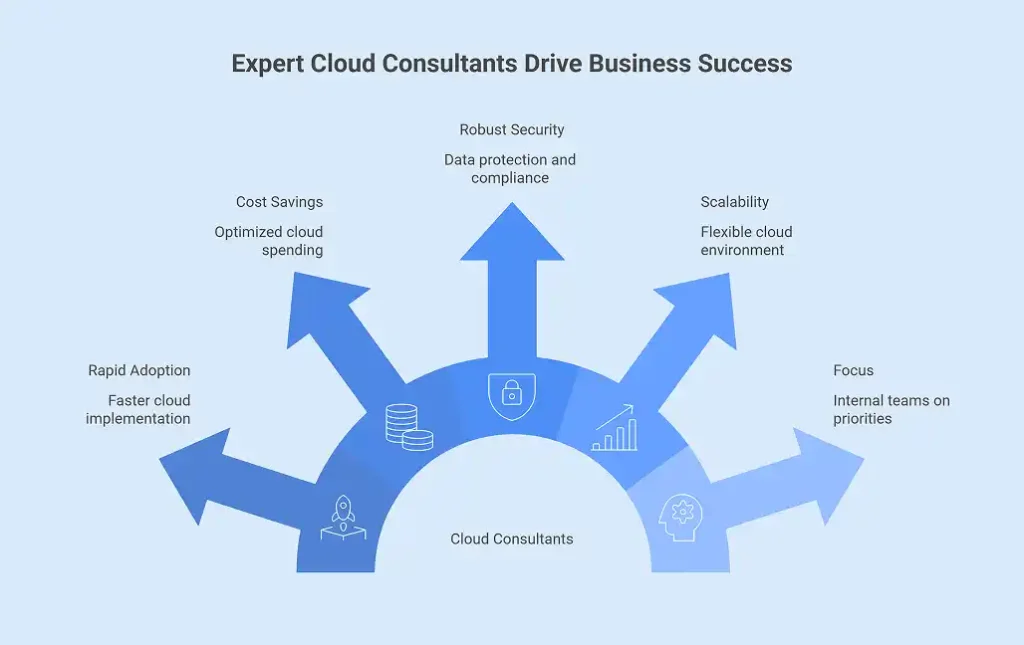
Engaging expert cloud consultants brings benefits of rapid and productive adoption of the cloud; a design with maximum efficiency, cost savings, compliance with complex regulations, and strong security, greater scalability and flexibility, allowing internal teams to focus on core business priorities.
Expertise & Strategic Planning: Leverage expertise in major cloud platforms (AWS, Azure, GCP) to develop a cloud strategy aligned with business objectives.
Cost Efficiency: Ensure spending is optimized by avoiding unnecessary services and choosing cost-competitive cloud service models.
Accelerated Migration & Deployment: While migrating to the cloud efficiently, minimize pre-existing downtime to avoid disruption to the business.
Robust Security & Compliance: To ensure data is fully protected at all times, strong controls are implemented to maintain compliance across industries.
Scalability & Agility: Create a cloud environment that can expand when needed and scale down when capacity is not required, assuring flexibility for supporting business growth.
Focus on Core Priorities: Outsourcing complex cloud management tasks to vendors enables internal teams to concentrate on innovation and strategic pursuits.
Seamless Integration: cloud services integrate with existing systems automatically; AI and Machine Learning tools can be leveraged to enhance functionality.
Future-Ready Infrastructure: Monitor and readjust continuously to keep the system operational and well-maintained throughout.
Why Choose Bloom as Your Expert Cloud Consultant?
Choosing Bloom as one of the best expert cloud consultants who gives you a seamless and effective cloud journey aligned with your business objectives. Our team integrates deep expertise acquired on leading platforms such as AWS, Azure, and GCP with extensive hands-on experience in cloud migration, security, cost optimization, and AI/ML integration. We craft architectures intended to scale, secure, and future-proof, manage dedicated deployments, and establish ongoing operational processes.
By integrating with Bloom, you will cut down your operational risk, optimize cloud spending, ensure full compliance with global regulations, and enable internal teams to focus on innovations and growth. With Bloom, you get seasoned guidance delivering tangible business results through cloud solutions.
Conclusion
Large cloud initiatives offer innovation, scaling, and operational efficiency. But they do encounter significant risks affecting security, compliance, cost, and continuity, which makes it one of the principal roles of cloud professionals to mitigate these risks. This is achieved by offering strategic direction, designing secure and scalable architectures, managing migration, ensuring compliance, and presenting a cost-saving layer. Organizations that have deep technical knowledge and industry experience can confidently navigate complicated cloud environments, speed up digital transformation, and prioritize their core competencies.
This is where consulting partners like Bloom become essential in providing a smooth, secure, and future-ready cloud journey that can generate measurable business value. If you are looking for expert cloud consultants, visit us here.
Frequently Asked Questions
Q1. What is the role of cloud consultants in cloud adoption?
Expert cloud consultants help clients to migrate or manage professional services, to assess, get started, and design an implementation strategy, to control migration on cloud principles, and keep up with the latest tools to suit company solution requirements, which is a benefit of enterprise-grade capabilities.
Q2. What are some of the cloud risk mitigation strategies?
De-risking the cloud involves some fundamental steps, which include Identity & Access Management (IAM), data encryption, Zero Trust, continued monitoring, security automation, and understanding the Shared Responsibility Model. Leading strategies include MFA, least privilege, data encryption (at rest & in transit), threat detection, regular audits, and robust backup/disaster recovery plans to mitigate breaches, misconfigurations, and compliance failures. For best results, businesses must hire expert cloud consultants.
Q3. How do you carry out cloud performance optimization?
Continuous monitoring allows expert cloud consultants to optimize cloud performance through rightsizing resources, a priori auto-scaling, eliminating dead resources, and leveraging cost-effective options beyond spot instances and reserved instances, guided by workload analysis and automation to ensure efficiency and cost control. Central to this are workload-pattern identification, classifying services based on demand, and using AI/ML to predict demand, as well as automated scaling and remediation.
Q4. What are the 4 types of cloud services?
Cloud services are mainly categorized into four types, called service models, which include Infrastructure as a Service (IaaS) for the basic building blocks, Platform as a Service (PaaS) for application development, Software as a Service (SaaS) for ready-to-use applications, and serverless computing, or Function as a Service (FaaS), for event-driven functions. They represent increasing levels of abstraction and management services.
Q5. What are the risks of migrating to the cloud?
In the process of migration, one of the most dangerous risks to data is the occurrence of data loss. Therefore, having the most recent data backup is essential. Backing up data before migration protects against any issues. Nonetheless, if you want to learn more about how data protection really works, our blog on cloud-Storage Backup and Recovery can help.
Q6. What are the 7 steps of cloud migration?
Often when the terminology “7 steps for cloud migration” is used, they are talking about the 7 Rs of cloud Migration Strategies, namely: Rehost (lift and shift), Replatform, Repurchase, Refactor/Rearchitect, Relocate, Retire, and Retain. These decisions provide a clear direction for each application, from easy relocations (Rehost) to a complete redesign (Refactor). Another seven-step structure for the process is Assess, Plan, Build & Migrate, Test, Optimize, Secure, and Govern.
Q7. What are the most common cloud threats?
When it comes to cloud security threats, the result could be a product of different threats, such as data breaches, unauthorized API access, human malfeasance, and configuration failures. The usual threats include account compromises, malware injections, bandwidth-abusing denial-of-service attacks, and inappropriate identity and access management policies.
Q8. What are the 4 C’s of cloud security?
Security in the cloud-native era is essentially divided into four layers: Code, Container, Cluster, and cloud. These layers must complement each other holistically to ensure that the resources they are intended to protect are secure. This approach creates a secure environment capable of defending against threats, which is a boon in today’s changing world.
Q9. What platforms do cloud consulting services cover?
Expert cloud consultants mainly deal in major platforms: AWS, Microsoft Azure, and Google Cloud Platform (GCP), including multi-cloud strategies as business demands.
Q10. How can these risks be minimized?
With the help of a phased migration strategy, cross-environment testing towards a sandbox is carried out along with strong security measures, system performance monitoring throughout the exercise, and expert hands-on cloud consulting.
Q11. Who benefits from enterprise cloud consulting?
Companies undergoing digital transformation need to embrace multiple cloud environments, AI/ML integration, and cost-efficiency, security, and operational capabilities enhancement.
Q12. What services are included in enterprise cloud consulting?
Enterprise cloud policy and architecture development has become more important than ever, with core roles in different areas, like shifting systems and setup, DevOps exposure, security and risk management, broad automation, AI/data interoperability, cost optimization, and ongoing managed services.


Recent Posts
- Azure Cloud Architecture Explained: A Simple Guide for Enterprises
- CI/CD Pipeline Setup in Azure: Best Practices for 2026
- DevOps vs DevSecOps: What’s the Difference?
- Hire Azure DevOps Developers Who Deliver Faster, Secure CI/CD Pipelines
- Azure Virtual Machines vs Containers: What’s Right for Your Infrastructure?