Smart Manufacturing Operations Powered by Azure

Table of Contents
About the Client
Our client is a mid-sized manufacturing company located in Pune, India, that makes components for the automotive and energy industries. The company had to upgrade its old infrastructure because it had multiple factories and a growing digital presence.
Their systems at work were disconnected from each other, hard to scale, and costly to maintain. The client wanted a cloud-first transformation enabled by Azure Cloud Services to help their business scale smoothly and get real-time insights into their manufacturing and supply chain processes.
Project Objective
The primary goal was to use Azure Cloud Services and Solutions to:
- Move essential workloads and databases with minimal disturbance.
- Set up safe, scalable storage and identity management.
- Allow access to production data from one platform in real time.
- Lay the groundwork for future hybrid integration with AWS.
Project Details
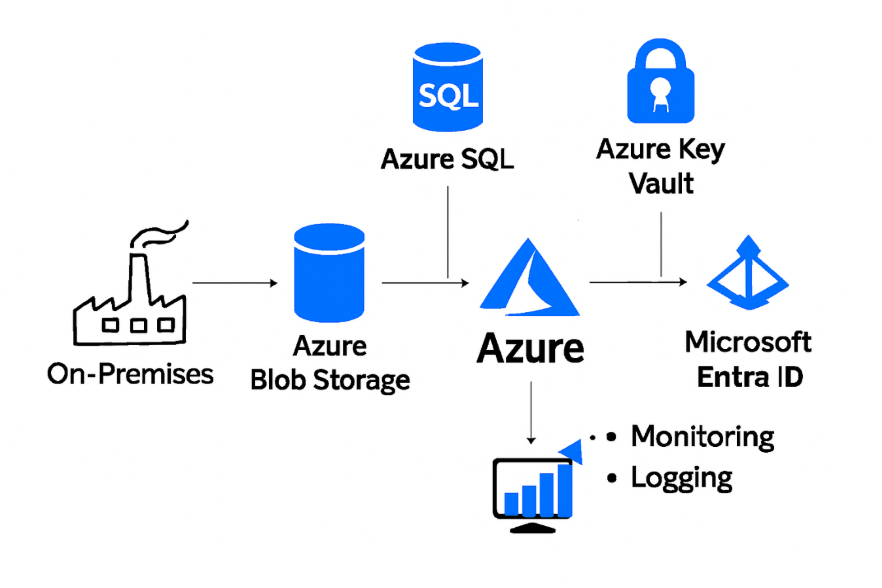
- Scope: Moving databases, file storage, and identification systems for ERP
- Duration: 4.5 months from the assessment to the deployment
- Workloads that were migrated:
- From SQL Server to Azure SQL
- File Servers to Azure Blob Storage
- Identity systems for Entra ID
- Secrets to Azure Key Vault
- Team: Cloud architect, security consultant, and IT leaders from the client side.
The move was done using Azure Cloud Services, making sure it could grow and cause the least amount of disturbance.
Engagement Model
- Remote delivery model with help for designing and deploying architecture.
- Weekly calls with the client’s CIO and plant IT managers to discuss governance.
- Agile execution with tracking based on milestones and a phased cutover.
Technology Highlights
The solution used Azure Cloud Services to improve performance and security.
- Azure SQL for hosting databases that may grow and are safe.
- Azure Blob Storage for storing unstructured data and backups
- Azure Key Vault for managing secrets and certificates.
- Entra ID (previously Azure AD) for managing access and identification from one place.
- Azure Storage Accounts for several levels of storage in hot, cool, and archive layers.
- Azure Monitor and Log Analytics are used to monitor performance and send alerts.
- Integration of AWS S3 and EC2 is planned for future hybrid workloads.
Potential Challenges
Technical Challenges
- Legacy systems weren’t ready for the cloud and needed refactoring.
- Schema normalization was needed to move data from on-prem SQL to Azure SQL.
- Ensuring there is no downtime during cutovers across production hours.
- Aligning security hardening with ISO 27001 for compliance
Non-technical Challenges
- Required training and change management across all departments.
- Concerns about data sovereignty and being stuck with a vendor.
- Making sure cloud expenditures fit within operational budgets.
Strategic Value by Bloom
The client was able to do the following by embracing Azure Cloud Services: .
- Provided a secure and scalable cloud foundation made uniquely for manufacturing processes.
- Lowered infrastructure costs and increased uptime at all plants.
- Allowed access to production data in real time so that decisions could be made faster.
- Provided internal IT teams with training and documentation on how to handle cloud assets
- Created dashboards for governance to keep track of costs and performance.
Market Value
The adoption of Azure Cloud Services made it possible for the client:
- To respond to supply chain problems more quickly because they were more flexible.
- To gain better data visibility, making it easier for them to plan inventory and make predictions.
- To establish themselves as a digitally advanced manufacturer, gaining trust from OEM clients.
- To cut IT maintenance expenses by 35%, giving the budget room for new ideas.
Delivery Approach
- Step 1: Check if the cloud is ready and make plans for moving.
- Step 2: Setting up Azure, moving workloads, and configuring security.
- Step 3: Support after deployment, training, and documentation.
- Ongoing optimization and cost management for three months after going live.
Results
- 99.9% uptime for all migrated workloads.
- 35% reduced costs of IT infrastructure.
- 40% faster access to production data across all plants.
- 50% faster backup and recovery times.
- 25% boost in operational efficiency because of better access to data.
The client was able to move to a modern and scalable infrastructure by using Azure Cloud Services. Ultimately, implementing Azure Cloud Services and Solutions helped the business grow over time while keeping operations stable.