Azure vs AWS for Startups: Which Platform Gives More for Less In 2026?
Today’s startups need to ship faster, deploy more reliably, and work better together. This is where Azure DevOps Pipelines can be quite helpful, especially when organizations are comparing Azure vs AWS for startups to establish scalable cloud infrastructures. Automation pipelines assist development teams in reducing manual labor, increasing the quality of the release, and maintaining the consistency between apps.
As cloud adoption increases, companies also analyze other variables like AWS vs Azure startup pricing, pay-as-you-go cloud pricing, scalability, and operational flexibility before they select the best cloud platform. Automation in DevOps pipelines enables continuous integration and continuous delivery, allowing teams to ship apps faster and with less downtime and deployment risk.
Startups trying to decide between Azure and AWS typically need expert help to build secure and scalable DevOps methods. Bloom Consulting Services helps firms develop, automate, and improve DevOps pipelines specific to startup growth goals. From deployment automation and infrastructure management to cloud optimization and migration support, it helps startups increase productivity, decrease operational complexity, and speed digital transformation.
Which Cloud Gives More Free Credits to Startups?
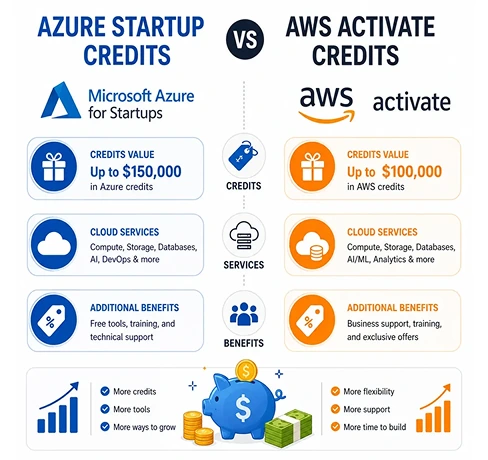
When startups enter the cloud ecosystem, they are generally looking for free cloud credits to lower their early operational costs. When comparing Azure vs AWS for startups, the focus is on startup financial support, cloud credits, benefits of startup programs, and long-term scalability. Cloud credits can let startups test workloads, build applications, and deploy environments without a heavy upfront commitment.
1. Startup Credit Programs Availability
Most cloud providers aiming to serve startups have programs aimed at supporting early-stage companies. These initiatives generally include infrastructure credits, technical assistance, and access to cloud resources. If comparing Azure vs AWS for startups, a common consideration is the flexibility and access to programs at different funding levels.
2. Credit Amount and Duration
The total value of startup credits will depend on investment level, business maturity, and accelerator agreements. Some platforms offer you more credits at the beginning, while others are about slow scaling assistance. For example, the free tier possibilities of Azure starter credits might appeal to enterprises where deeper enterprise integration is a priority, whereas AWS Activate credits for startups are frequently selected for infrastructure-heavy workloads.
3. Eligibility Requirements
Each cloud provider has its own rules for eligibility. Some programs only work with venture-backed firms, while others also support bootstrapped companies. Startups should consider factors such as documentation requirements, approval deadlines, and technical support availability when comparing Azure vs AWS for startups to choose the right provider.
4. Services and Resources
Free cloud credits generally include computation, storage, networking, AI tools, and DevOps services. The effectiveness of these benefits depends on the workloads and scaling requirements of the startup. When looking at the best cloud provider for companies, many founders look at the services available that map to their product roadmap.
5. Effect on Early-Stage Budgeting
Product development and testing can be costly in terms of infrastructure, but cloud credits might help to offset those costs. This enables startups to focus on driving innovation and acquiring customers. Businesses looking at AWS for startups pricing will frequently look at how much operational runway free credits can offer.
6. Ability to Scale Past Free Credits
Free credits are great in the outset, but startups need to consider the costs once the credits are gone. Azure vs AWS for startups comparison should also incorporate the future prices of infrastructure, automation tools, and workload management capabilities to avoid unforeseen operational expenses.
Comparing AWS vs Azure for Startups in 2026?
Choosing the Cloud provider in 2026 will depend on the business goals, technological needs, and target scalability. Many firms comparing Azure vs AWS for startups will examine pricing flexibility, maturity of the ecosystem, AI integration, DevOps capabilities, and long-term operational effectiveness before making their pick.
| Comparison Area | Azure | AWS |
| Startup Support Programs | Strong enterprise-focused startup support | Broad startup ecosystem support |
| Free Credits | Flexible startup credit programs | Widely recognized startup credits |
| Infrastructure Reach | Strong hybrid cloud integration | Extensive global infrastructure |
| DevOps Integration | Deep integration with development tools | Advanced automation capabilities |
| AI and Analytics | Enterprise AI and analytics strengths | Broad AI service portfolio |
| Pricing Flexibility | Competitive pay-as-you-go cloud pricing | Flexible usage-based pricing |
| Scalability | Suitable for growing enterprise startups | Ideal for rapid infrastructure scaling |
| Security Features | Enterprise-grade compliance tools | Advanced cloud-native security |
| Migration Support | Strong enterprise migration services | Large ecosystem for migration |
| Startup Adoption | Increasing startup adoption globally | Widely used by technology startups |
1. Cost Efficiency for Startups
Pricing flexibility is still one of the primary concerns in Azure vs AWS for startups’ decisions. For startups, it is generally calculated based on compute use, storage expenses, and how well they scale operations. Usage-based pricing strategies can assist businesses with variable workloads.
2. Development and Implementation
Cloud-native DevOps technologies help startups increase release cycles & deployment automation. Founders often examine pipeline automation, monitoring features, and infrastructure-as-code support when choosing the ideal cloud platform for startups.
3. Long-Term Business Growth
The ideal cloud provider should enable you to scale quickly without incurring operational complexity. Review studies from cloud platform comparison startups to see how each platform performs with scaling workloads, worldwide expansion, and application modernization.
4. Ecosystem and Support for Startups
Cloud providers with strong startup environments usually offer technical mentorship, architectural help, and integration support. If you’re a startup weighing Azure vs AWS, you’ll want to consider the training resources and partner support networks that are accessible before you commit to a long-term relationship.
Reduce Cloud Costs Faster

What Cloud Do Most Startups Use in 2026?
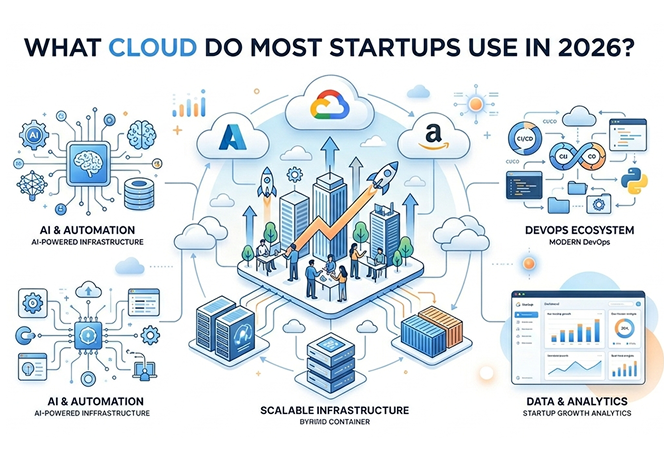
In 2026, the focus will be on scalability, cost containment, and innovation, with startups leading to the charge on cloud adoption trends. Startups typically compare Azure to AWS by looking at trends in market adoption, developer preference, and industry-specific market cloud usage before they decide on a platform.
1. Popular with Technology Startups
Technology companies often choose providers based on the maturity of the ecosystem and the flexibility of the infrastructure. Cloud adoption is typically a function of workload requirements, product complexity, and the finance stage. If companies are seeking the best cloud provider for startups, scalability and developer-friendly services are usually at the top of the list.
2. Impact Of Free Tier Programs
Startups in the early phases of their growth are heavily influenced by the free-tier offerings. Startups can test services using AWS free tier for startups and Azure startup credits free tier programs before investing much in infrastructure.
3. Cloud Preferences by Industry
Different sectors often select different cloud providers based on regulatory and workload needs. For example, in Azure vs AWS for startups, healthcare, finance, and enterprise SaaS businesses may favor advanced governance capabilities, whereas application-focused startups may prioritize infrastructure flexibility.
4. Hybrid and Multi-Cloud Strategy Growth
Many firms no longer have to stick with one cloud provider. Businesses are increasing their utilization of hybrid and multi-cloud environments in their pursuit of operational resilience and price efficiency. This tendency is impacting talks at cloud platform comparison startups since flexibility has become a big deciding factor.
5. The Role of Automation and Artificial Intelligence
Now, startups’ cloud decisions are strongly driven by artificial intelligence and automation capabilities. When choosing between Azure vs AWS for startups, those that are developing AI-powered products will consider how well the cloud vendors support machine learning, automation, and analytics workloads.
6. Emerging Trends in Startup Migration
Many firms start with one cloud provider and then optimize workloads across many platforms. Such decisions are generally motivated by startup cloud migration cost considerations, especially when extending applications across international boundaries or updating infrastructure.
Also Read: Azure AI offerings vs AWS & Google AI: Who Leads in 2026?
How to Choose Between AWS vs Azure for Startup?
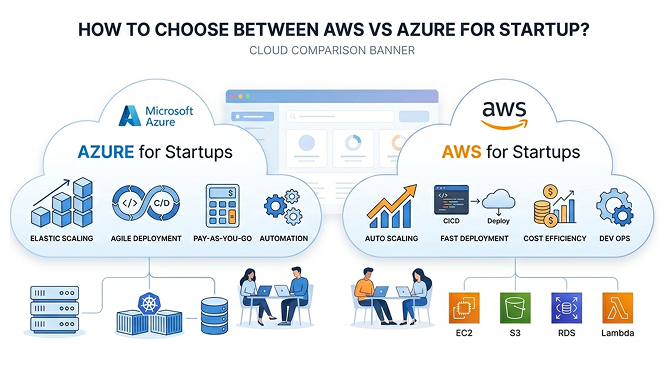
Choosing the right cloud platform is a balancing act, weighing technological requirements, budget expectations, and future business ambitions. When comparing Azure vs AWS for startups, look beyond the trends. Operational flexibility, development efficiency, scalability, and long-term infrastructure management are all important factors to consider.
1. Define Business Requirements First
The initial step is to understand application requirements, expected traffic, and operational priorities. When comparing Azure vs AWS for startups, an enterprise application company would look at the platforms differently than a SaaS startup or a mobile application company.
2. Evaluate Pricing & Resource Usage
Cloud selections are heavily influenced by pricing models.” Founders should examine AWS for startups pricing, Azure for startups cost, and ongoing infrastructure charges, depending on anticipated workload patterns. Startups can manage operational spending as they grow by using cloud pricing with pay-as-you-go plans.
3. Scalability and Flexibility Assessment
The cloud platform should be capable of accommodating future scales without too much complexity in the infrastructure. When choosing the best cloud platform for startups, organizations expecting rapid user growth usually consider automation, orchestration, and deployment features.
4. DevOps and Automation Features Overview
Cloud-native DevOps solutions increase release management, monitoring, and deployment consistency. When comparing Azure vs AWS for startups, businesses need to consider CI/CD automation, container support, and infrastructure management capabilities.
5. Think of Moving and Expansion Plans
The selection method must consider future migration demands. If the infrastructure is not built to be flexible, the cost of a startup cloud migration can climb dramatically. Global availability and regional assistance are important for startups considering geographic expansion.
6. Evaluate Security and Compliance Requirements
Different industries have different security requirements, and different customers have different expectations. Startups that work with sensitive data typically look for governance, identity management, and compliance features when evaluating cloud providers.
7. Technical Support and Guidance for Partners
Implementation and optimization become easier when working with skilled cloud and DevOps specialists. If your business is thinking about Azure vs AWS for startups, they frequently benefit from experienced coaching to increase deployment speed, cost control, and operational stability.
Conclusion
2026 is a year where cloud platforms continue to change the way startups build, scale, and innovate. When comparing Azure vs AWS for startups, organizations should evaluate pricing flexibility, automation features, startup support programs, scalability, and operational efficiency. The best decision hinges on the workload needs, growth trajectories, and long-term digital transformation ambitions.
Automation of DevOps pipelines improves startup operations by ensuring consistency in deployment, eliminating manual intervention, and expediting product delivery cycles. If done right, entrepreneurs may boost cooperation, increase software quality, and respond faster to the changing market demands.
Bloom Consulting Services assists startups with cloud consulting, DevOps automation, infrastructure optimization, and migration support. By connecting cloud strategies with business objectives, startups may construct scalable, cost-effective, and future-ready digital environments.
Upgrade Your Cloud Strategy
Frequently Asked Questions
Q.1 What is the best cloud platform for startups?
Choosing the best cloud platform for businesses is a decision based on scalability, pricing flexibility, automation, security, and startup credits. The platform should be selected based on the long-term growth, operational efficiency, and development goals of the business.
Q.2 How do I choose the best cloud provider for startups?
Startups should look at cost, infrastructure scalability, dev-ops capabilities, security features, support services, and startup programs. By evaluating technical needs and predicted growth, companies can select the most suitable cloud provider. Comparing Azure vs AWS for startups can further help businesses determine which platform offers better flexibility, pricing, and long-term value.
Q.3 How much does Azure for startups cost?
Azure cost for startups is based on consumption of computation, storage, networking, and managed services. With pay-as-you-go pricing and startup credits, companies can lower the cost of infrastructure as they start and grow. When evaluating Azure vs AWS for startups, many businesses choose Azure for its flexible pricing and startup-friendly scalability.
Q.4 What factors influence AWS for startups’ pricing?
AWS launch pricing depends on the size of the workload, storage, amount of traffic, automation tools, and services you select. Costs increase as infrastructure usage scales, making continuous optimization important for budget management.
Q.5 Why is cloud platform comparison important for startups?
Cloud platform comparisons help firms assess pricing, scalability, security, automation, and migration support. By comparing platforms, businesses can guarantee they are choosing an infrastructure that will support operational efficiency, growth, and long-term application performance.
Q6. Which offers better AWS vs Azure value for money?
AWS vs Azure value for money relies on your workload requirements, scaling demands, and enterprise integration preferences. Before picking up, businesses should look at infrastructure costs, startup credits, automation possibilities, and support services. Comparing Azure vs AWS for startups can help companies identify the most cost-effective and scalable cloud environment for long-term growth.
Q.7 What are AWS Activate credits for startups?
AWS Activate credits enable companies to access cloud finance, technical resources, training, and infrastructure support. Such credits assist firms in lowering their initial operating expenses while efficiently designing, testing, and growing cloud-based apps.
Q.8 What does Azure startup credits free tier include?
The free tier of Azure generally provides access to computing services, storage, networking, developer tools, and AI capabilities. These features enable startups to experiment, launch applications, and efficiently control the expenses of infrastructure.
Q.9 How does AWS free tier for startups help businesses?
AWS free tier for startups provides the chance to use restricted cloud services without upfront infrastructure costs for businesses. It helps to test, develop, and deploy applications and helps entrepreneurs understand cloud resource management.
Q.10 What affects the startup cloud migration cost?
The cost of migrating a startup to the cloud relies on the complexity of the application, the amount of data, the need to restructure the infrastructure, the risk of downtime, and the migration timetable. Careful planning and automation, where it makes sense, can mitigate operational disruption and unneeded investment while migrating. Evaluating Azure vs AWS for startups can also help businesses choose a cloud platform that aligns with their budget, scalability, and operational goals
Q11 How can startups reduce startup cloud migration costs?
Startups can save on startup cloud migration costs by reducing workloads, automating deployments, limiting downtime, and choosing scalable infrastructure. Planning for relocation by experts enhances efficiency and reduces longer-term operating costs.
Q.12 What is pay-as-you-go cloud pricing?
With pay-as-you-go cloud pricing, businesses pay only for what they use. This methodology allows startups to manage infrastructure costs and be scalable and operationally flexible as the business grows.
Table of Contents
Schedule A Free Call Now !
Fill Out the Form and Our Experts Will Contact You Within 24 Hrs
Recent Posts
- Why Your AWS Bill Increased After Migration (And How to Fix It Fast)
- Best AWS Cloud Management Tools to Simplify Cloud Operations
- AWS Consulting Partner vs In-House Cloud Teams: What Businesses Should Consider
- AWS Migration Checklist: What Businesses Should Prepare Before Migrating Applications
- Key DevOps Best Practices for Applications Running on AWS