Hire Azure DevOps Developers Who Deliver Faster, Secure CI/CD Pipelines

Not just buzzwords, speed, safety, and reliability are what set the different stages of software delivery apart today. Releases need to happen quickly, but they can’t affect operations or compliance. This is why a lot of businesses hire Azure DevOps developers who can build secure and automated CI/CD pipelines that grow with the business.
Azure DevOps is more than just a set of tools. It is a framework for continuous integration and delivery (CI/CD), automating infrastructure, and working together across teams. When done right, it cuts down on downtime, speeds up deployments, and makes security controls stronger in all environments.
Azure DevOps CI/CD: Understanding the Framework
Microsoft’s Azure DevOps is a platform that helps with every step of the software development process, from planning and coding to testing and deployment.
CI/CD stands for “Continuous Integration and Continuous Delivery.” It is a set of automated processes that
- Make changes to the code often,
- Run tests that are done automatically,
- Put apps on staging or production servers.
When teams use Azure DevOps CI/CD, they can recover from mistakes made manually, speed up the delivery of software, and keep up with governance standards. To get the most out of these processes, businesses should hire Azure DevOps Developers who can build strong pipelines and make sure they can grow over time.
Read More : When Should Businesses Hire DevOps Engineers for Cloud-Scale Delivery?
Why Hire Azure DevOps Developers for Secure CI/CD?
Speed and safety must go hand in hand. Automated pipelines that don’t have the right security controls pose certain risks.
When companies hire Azure DevOps developers, they get access to the professionals who:
- Set up a secure pipeline.
- Administer RBAC, or role-based access control.
- Use Azure Key Vault to manage secrets.
- Govern Infrastructure as Code (IaC).
- Deploy workflows that are ready for compliance.
A good Azure DevOps engineer makes sure that security checks are built right into pipelines instead of being added later. This is often referred to as “shift-left security,” which implies that risks are dealt with early in the development process.
Hire Azure DevOps Experts Now

What Are the Responsibilities of An Azure DevOps Engineer?
Understanding Azure DevOps engineer responsibilities helps you figure out what to look for when hiring.
Some of their common responsibilities include:
- Creating and keeping an eye on CI/CD pipelines.
- Using tools like ARM templates or Terraform to automate infrastructure.
- Running Azure environments and keeping an eye on performance.
- Adding security scans to the process of deploying.
- Working together with the operations and development teams.
- Making sure that high availability and disaster recovery are ready.
An experienced engineer makes sure that the CI/CD pipeline runs smoothly, which speeds up the build process and lowers cloud costs. That’s why businesses hire Azure DevOps developers – they are the engineers who specialize in automation skills, cost-cutting, and safe cloud delivery for long-term efficiency.
What Skills Are Required for an Azure DevOps Engineer?
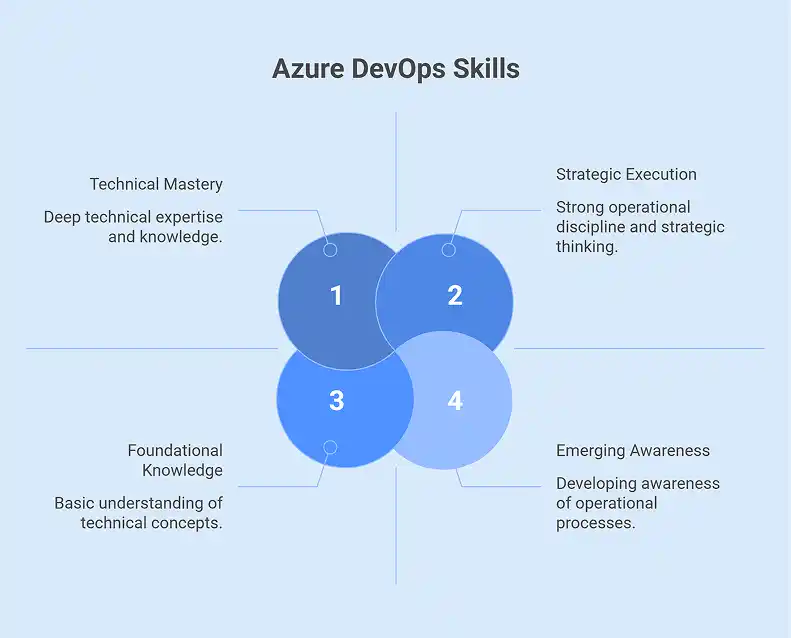
To hire the right person, you need to know what kind of technical depth and operational discipline this job requires. Most of the time, the skills required for Azure DevOps engineer are:
Technical Skills
- Expertise and knowledge about Azure cloud services.
- Have worked with Azure Pipelines and Repos.
- Infrastructure as Code (ARM, Bicep, and Terraform).
- Containerization (AKS, Docker, and Kubernetes).
- Scripting languages include PowerShell, Bash, and Python.
- Best security practices for CI/CD.
- Tools for monitoring, such as Azure Monitor and Application Insights
Process Skills
- Knowing about the culture of Agile and DevOps.
- Awareness of risk management and compliance.
- Communication between different departments.
When companies hire DevOps engineers, they shouldn’t just look at how well they know the tools. They should also notice how well they can think about architecture and security. That’s why a lot of companies hire Azure DevOps developers who can make decisions that are both technical and focused on architecture and security.
What Should I Look for When Hiring Azure DevOps Developers?
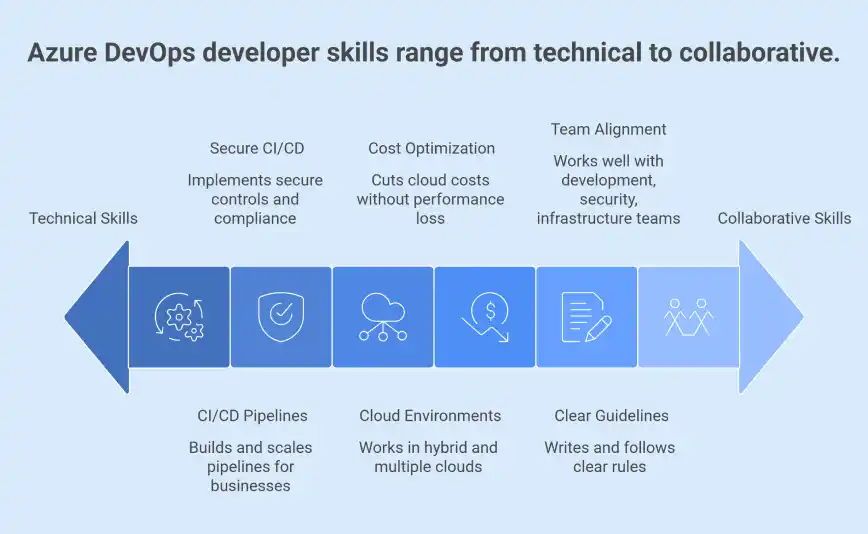
When looking at candidates or partners, don’t just look at their certifications; look at what they actually bring to the table.
To successfully hire Azure DevOps Developers, focus on professionals who have:
- Proven experience building and scaling CI/CD pipelines for large businesses.
- A deep understanding of how to implement secure CI/CD and compliance controls.
- Worked in environments with both hybrid and multiple clouds.
- The ability to cut cloud costs without hurting performance.
- Clear rules and guidelines for writing and following them.
In addition to these technical skills, analyze how well they work with the development, security, and infrastructure teams. Strong alignment among departments makes DevOps projects bring long-term value to the business.
Hire Azure DevOps developers who don’t just focus on quick fixes but also think about the long-term effects on the building.
What is the Difference Between an Azure DevOps Engineer and a Developer?
Companies that want to hire Azure DevOps developers need to know exactly how this job is different from a regular software developer’s job in order to build CI/CD pipelines faster and more securely. Most companies use the term “Azure DevOps developer” to refer to the same job as an “Azure DevOps Engineer”.
| Aspect | Developer | Azure DevOps Engineer |
| What they primarily do | Build features, write code, and improve application functionality | Set up and manage automated pipelines that build, test, and deploy applications |
| Day-to-day focus | Solving product problems and implementing business requirements | Ensuring smooth releases, system stability, and deployment reliability |
| Involvement in infrastructure | Usually limited to application-level configurations | Works directly with cloud infrastructure, automation scripts, and environment setup |
| Role in deployments | Hands over completed code for release | Owns the automation and security of the release process |
| Overall contribution | Expands product capabilities | Enables faster, safer, and more consistent delivery |
In reality, the two roles work together very closely. Developers write code to add value, while Azure DevOps Engineers make sure that value gets to production safely, quickly, and on a large scale.
When Should a Company Hire Azure DevOps Developers?
Timing is very important for DevOps to work successfully. A lot of companies don’t realize they need to hire Azure DevOps developers until problems with delivery start to hurt performance, security, or cost control.
Companies usually hire Azure DevOps experts when:
- Releases of applications become slow, erratic, or difficult to predict.
- Deploying manually causes mistakes or downtime.
- Security audits show where CI/CD pipelines are weak.
- Costs for cloud infrastructure keep going up, but it’s hard to see them.
- Growth needs automation that can grow in different environments.
If teams are having trouble with release reliability, governance requirements, or compliance readiness, it might be time to hire dedicated DevOps developers to make delivery processes more stable and up-to-date.
Is It Cheaper to Outsource Azure DevOps Developers?
An important factor for companies that want to hire Azure DevOps developers is to think about cost-effectiveness and the value they bring in the long run.
In the following situations, outsourcing can be a good choice:
- A short-term project needs someone with specialized Azure knowledge
- Internal teams don’t have the advanced Azure DevOps features they need
- A quick upgrade to the cloud must happen without long hiring cycles.
- An independent audit or redesign of CI/CD is necessary
In these situations, companies often hire DevOps consultants to help them plan their architecture or check their security. A lot of businesses also avail Azure DevOps consulting services to help with migration, setting up governance, or improving their pipelines.
But when making a decision, you should think about more than just hourly rates. You must consider:
- Long-term ease of use
- Aligning security and compliance
- Passing on knowledge to teams within the company
- Taking charge of DevOps processes strategically
Cost savings are important, but operational stability and governance readiness are even more so.
How to Choose the Best Hiring Model for Azure DevOps Developers?
When companies hire Azure DevOps developers, it’s important to be clear about the engagement model so that there is no long-term confusion or misalignment. The job being filled in a business setting is usually the same as the Azure DevOps Engineer position that is well-known in the industry.
To make sure the information is correct, the table below uses standard terms.
| If You Choose | What It Typically Looks Like | When It Makes the Most Sense | What to Keep in Mind |
| A Full-Time In-House Azure DevOps Engineer | A dedicated team member who owns CI/CD pipelines, automation, and release governance on an ongoing basis | You are building long-term DevOps capability and want deep internal expertise | Requires time for hiring, onboarding, and retention planning |
| A Project-Based Azure DevOps Consultant | An external specialist brought in to solve a specific problem such as migration, pipeline redesign, or compliance audit | You need focused expertise for a defined initiative | Plan early for documentation and knowledge transfer |
| A Hybrid Approach | Internal engineers handle daily operations, while external experts guide architecture and best practices | You want operational control but also strategic direction | Clear role boundaries prevent duplication or confusion |
Before you hire Azure DevOps engineers, think about whether your top priority is long-term change, quick execution, or balanced scalability.
When companies hire Azure DevOps developers, they often use the hybrid structure because it provides stability and expert oversight without changing the structure in the long term.
Expert Advice from Bloom Consulting Services
Experts from Bloom Consulting Services opine that process alignment is more important than tools for successfully adopting Azure DevOps. Companies that line up their DevOps goals with their business KPIs see a measurable ROI.
Our Azure consultants recommend that instead of only relying on audits after deployment, you should include automated security testing directly in your Azure DevOps CI/CD pipelines.
Bloom has observed that in enterprise projects, poorly structured pipelines make cloud usage more expensive because they lead to unnecessary builds and environments that aren’t effective.
These insights show how important it is for businesses to plan when they hire Azure DevOps developers.
Things to Remember Before You Hire
Before you hire Azure DevOps developers, you should:
- Assess the level of maturity in DevOps.
- Define requirements for security and compliance.
- Set target frequency of deployment.
- Make sure your new tools work with your old ones.
- Establish a long-term ownership plan.
Clear internal alignment lowers the risk of hiring the wrong person and makes it more likely that the plan will work.
Key Takeaways
- When you hire Azure DevOps developers, make sure they have a lot of experience with secure CI/CD automation, cloud governance, and infrastructure as code.
- Azure DevOps engineers need to know a lot about Azure, scripting, containerization, and security-focused architecture.
- When releases slow down, manual deployments become risky, or scaling needs automation; companies should think about hiring.
- The best way to hire Azure DevOps developers depends on how mature your DevOps is, what your compliance needs are, and how you plan to scale.
Conclusion
The decision to hire Azure DevOps developers is more than just filling a technical gap; it also affects how quickly you can release software, how secure it is, and how resilient your operations are. DevOps can either give you a competitive edge or make things more complicated, depending on how well you align roles, govern, and engage with the right model. With the right guidance and a structured approach from a reputed company like Bloom, businesses can improve their DevOps maturity while maintaining security, compliance, and long-term operational stability.
Are you looking to hire Azure DevOps developers? Partner with Bloom to set up safe, dependable Azure DevOps environments and upgrade your DevOps architecture. Get in touch with us today!
Frequently Asked Questions
Q1. What is the main benefit of using Azure DevOps?
Ans: The main benefit of Azure DevOps is that it automates everything from code to deployment. It speeds up releases, makes things clearer, and keeps development and operations on the same page.
Q2. Is DevOps a dead-end job?
Ans: Not at all. DevOps is moving toward more strategic roles like Platform Engineering and SRE. Those who learn more about AI, the cloud, and security will always remain valuable assets.
Q3. Will AI replace Azure DevOps?
Ans: No, AI makes DevOps better by repetitive tasks. But decisions about architecture, risk management, and working together across teams remain unique to human expertise.
Q4. What are the roles in Azure DevOps?
Ans: Developers, testers, and release managers usually work together in Azure DevOps. Each role is focused on building, testing, and delivering software quickly and appropriately.
Q5. What are the 7 C’s of DevOps?
Ans: The 7 C’s are Continuous Development, Integration, Testing, Delivery, Monitoring, Feedback, and Operations. They work together to ensure that software is delivered faster, more reliably, and with greater collaboration.
Q6. What are the 5 components of Azure DevOps?
Ans: Azure Boards, Azure Repos, Azure Pipelines, Azure Test Plans, and Azure Artifacts are the five main components of Azure DevOps. They all work together to handle planning, coding, testing, CI/CD, and package management.
Q7. What does an Azure DevOps Engineer do?
Ans: An Azure DevOps Engineer makes and runs CI/CD pipelines, automates deployments, and makes sure that apps work well in the cloud. They connect development and operations to make software faster and more reliable.
Q8. What skills do you need for Azure DevOps?
Ans: You should have good scripting and automation skills and have experience with CI/CD tools like Azure DevOps Services, Jenkins, or GitHub Actions. It is also important to be able to handle builds, deployments, and automated testing.
Table of Contents
Schedule A Free Call Now !
Fill Out the Form and Our Experts Will Contact You Within 24 Hrs
Recent Posts
- Why Your AWS Bill Increased After Migration (And How to Fix It Fast)
- Best AWS Cloud Management Tools to Simplify Cloud Operations
- AWS Consulting Partner vs In-House Cloud Teams: What Businesses Should Consider
- AWS Migration Checklist: What Businesses Should Prepare Before Migrating Applications
- Key DevOps Best Practices for Applications Running on AWS